With recreational cannabis legal and widely available in California, you might be asking yourself, "Is getting a medical marijuanas card still worth it?" For anyone who relies on cannabis for their well-being, the answer is a definite yes.
A medical card unlocks some serious perks, from significant savings at the register to higher possession limits and crucial legal access for younger adults.
Why a Medical Card Still Matters in California
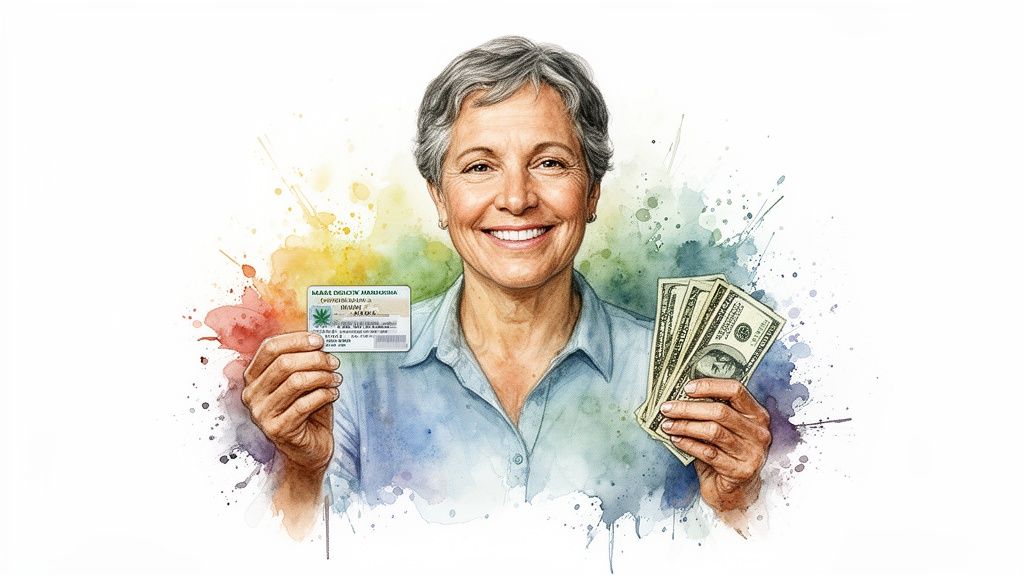
It’s a common misconception that California's adult-use market made the medical program obsolete. That couldn't be further from the truth.
Having a doctor's recommendation or a state-issued Medical Marijuana Identification Card (MMIC) gives you a set of advantages that recreational customers just don't get. These benefits are specifically designed to make cannabis more affordable and accessible for people using it for legitimate health reasons.
To give you a quick side-by-side look, here’s how the two stack up.
Medical Card vs Recreational Use: A Quick Comparison
| Feature | Medical Patient (with MMIC/Recommendation) | Recreational User (21+) |
|---|---|---|
| Minimum Age | 18+ with a qualifying condition | 21+ |
| Tax Savings | Exempt from state sales & use tax (MMIC holders) | Pays all state & local cannabis taxes |
| Possession Limit | Up to 8 ounces of cannabis | 1 ounce of flower, 8 grams of concentrate |
| Product Access | Access to medical-only products and higher potencies | Access to general adult-use products |
| Legal Protections | Stronger legal protections related to medical use | Standard legal protections for adult use |
This table just scratches the surface. Let's dig into what these differences really mean for you.
Save a Ton of Money
The most immediate and tangible benefit is the tax savings. Recreational buyers get hit with a triple whammy of taxes: state excise tax, state sales tax, and local cannabis taxes, which can easily tack on 15% or more to the final price.
If you have an MMIC, you are exempt from the state sales and use tax. For a patient managing chronic pain and spending, say, $200 a month on cannabis, those savings can add up to hundreds of dollars a year. That’s real money back in your pocket.
This isn’t just a discount; it's a recognition that for many, cannabis is a medical necessity, not a luxury. The tax break makes consistent treatment much more sustainable.
Buy and Carry More
California's recreational laws limit adults to purchasing and possessing one ounce (28.5 grams) of flower and eight grams of concentrate at a time. For someone dealing with a severe or chronic condition, that might barely last a week.
A medical marijuana card gives you the freedom to manage your health on your own terms. Medical patients can legally possess up to eight ounces of cannabis.
This higher limit means fewer trips to the dispensary and less stress about running out of your medicine. It ensures you have an adequate supply when you need it most.
Legal Access for Young Adults
To buy recreational cannabis in California, you have to be 21 or older, no exceptions. But what about younger adults who need it for medical reasons?
A doctor's recommendation provides a legal, safe, and regulated pathway for individuals aged 18 to 20 to access cannabis for qualifying health conditions. This is a critical lifeline for young adults who would otherwise have no legal way to get the products they need. Learning the difference between medical and recreational dispensaries can help clarify why this access is so important.
Do You Qualify for a Medical Card
Before you start the application process, it's a good idea to figure out if you even qualify for a medical marijuana card in California. The good news is, the requirements are often more inclusive than people think, covering a lot more than just a short list of severe illnesses.
To get the green light, you’ll need to check three main boxes.
First, you have to be a California resident. This one is non-negotiable. You'll need to show proof, like a California driver's license or ID. If you don't have one of those handy, don't worry—other documents like a recent utility bill or a lease agreement with your name and a California address usually do the trick.
Second, you have to be at least 18 years old. It's still possible for patients under 18 to qualify, but they'll need a primary caregiver—typically a parent or legal guardian—to manage their medical cannabis for them.
Understanding Qualifying Conditions
This is where a lot of people get tripped up. While California law specifically lists serious conditions like cancer, AIDS, and chronic pain, it also leaves the door open with a much broader category that gives doctors a lot of discretion.
The law includes "any other chronic or persistent medical symptom" that either:
- Substantially limits your ability to conduct one or more major life activities.
- May cause serious harm to your safety, physical or mental health if not alleviated.
That broad definition is the key takeaway here. It means that if a condition is genuinely messing with your daily life, there's a good chance it qualifies, even if it's not on the short-list of named illnesses.
This inclusive language is really there to empower doctors to use their professional judgment. If your condition truly impacts your quality of life, you probably have a strong case for a medical recommendation.
For instance, a lot of people don't realize that severe, persistent anxiety can be a qualifying condition. If anxiety keeps you from working, being social, or even just leaving the house, it’s clearly limiting major life activities. Many patients have found relief by exploring some of the best strains for anxiety with a doctor's guidance.
Common Examples of Qualifying Symptoms
To help you see how your own situation might fit the state’s guidelines, here are a few real-world scenarios that often qualify under those broader criteria:
- Severe Insomnia: If not being able to sleep consistently wrecks your ability to function during the day, that's a valid medical symptom.
- Debilitating Migraines: Chronic migraines that get in the way of your work, family life, or basic daily tasks are a textbook example.
- Persistent Nausea: Whether it's from chemotherapy or another medical issue, ongoing nausea is a classic qualifying symptom.
- Severe PMS or Menstrual Pain: If the pain is so bad that it's incapacitating you every month, it can absolutely qualify.
Ultimately, the decision is up to a licensed California physician. Just make sure you have your proof of residency ready and a clear idea of your symptoms, and you'll be well-prepared for your evaluation.
Navigating the Doctor's Recommendation Process
Getting a doctor's recommendation is the absolute first step toward getting your medical marijuanas card. Thankfully, the whole thing is way less complicated than most people think, whether you go to an old-school clinic or use a modern online service.
At its core, the evaluation is just a confidential chat between you and a licensed doctor. They’ll ask about your medical history and the symptoms you’re dealing with. It’s their job to figure out if cannabis is a good, safe option for what’s ailing you.
This chart breaks down the three basic things a doctor will confirm during your visit.
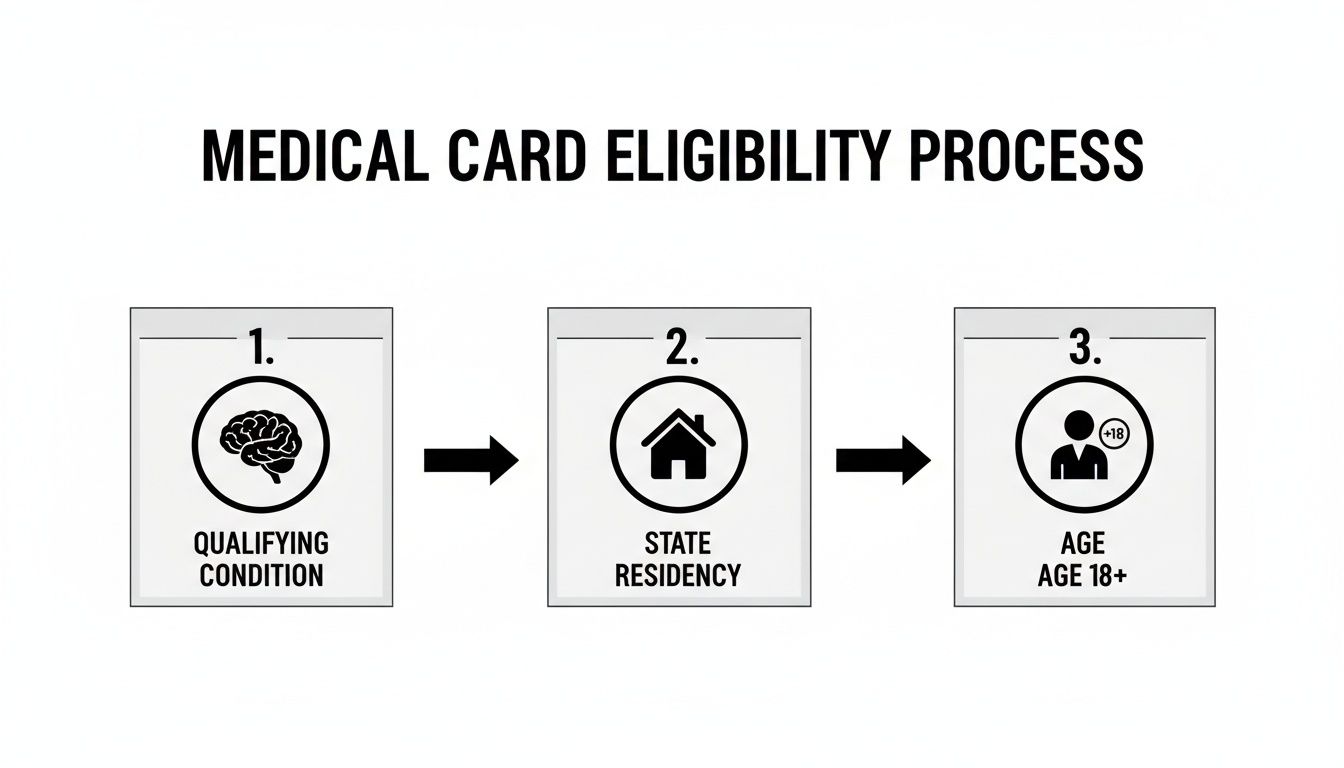
As you can see, it really boils down to having a qualifying condition, living in California, and being old enough.
Preparing for Your Evaluation
A little prep work can make your consultation go a lot smoother. Before your appointment, it’s a good idea to gather your thoughts and a few key documents. This helps you explain your situation clearly so the doctor can make an informed decision.
Here’s a quick checklist of what to bring:
- Proof of California Residency: Your state ID is perfect. A recent utility bill or rental agreement usually works in a pinch, too.
- Medical Records: These aren't always mandatory, but if you have paperwork about your condition (like diagnoses or prescription lists), it can definitely help.
- Symptom Notes: Just jot down a few notes about your symptoms—when they started, what makes them worse, and what you’ve already tried.
Being open and honest is key here. Remember, it's a medical appointment, so everything is protected by patient confidentiality. The more detail you can give about your pain, anxiety, or sleepless nights, the better the doctor can understand what you're going through.
Online vs In-Person Consultations
One of the biggest choices you'll make is how to see the doctor. Both telemedicine and in-person visits have their own perks.
Online services are incredibly convenient. You can do the whole evaluation from your couch, often in under 30 minutes, and get a digital copy of your recommendation almost instantly. On the other hand, some patients just prefer the traditional, face-to-face interaction you get at a physical clinic.
No matter which route you choose, the medical standards are the same. The global medical marijuana market hit $20.32 billion in 2024, which shows just how accepted and regulated this process has become. With 42 states plus D.C. allowing medical cannabis, over 80% of Americans now live somewhere with access. You can find more info on the global medical cannabis market on Precedence Research.
Here in California, that recommendation is your ticket to getting premium products at dispensaries like Cannavine from top brands like Alien Labs or Sauce Essentials—often with great tax savings.
Key Takeaway: The doctor's recommendation is your legal key to access medical cannabis. The state-issued MMIC is an optional but highly valuable upgrade that unlocks significant tax savings and stronger legal protections.
Once the evaluation is done, you'll get your official doctor's recommendation. That piece of paper is all you need to purchase medical cannabis anywhere in California. From there, you can decide if you want to take the next step and apply for a state-run Medical Marijuana Identification Card (MMIC) to really maximize your benefits.
Understanding the Costs and Renewal Cycle
Getting your medical marijuanas card is an investment in your well-being, so it helps to know what to expect financially. The biggest cost is the physician's evaluation, and the price tag on that can swing quite a bit.
You'll see online services offering consultations for as little as $39, while a more traditional in-person visit with a specialist might run you closer to $100-$200. Why the big difference? It mostly comes down to overhead. Digital platforms just don't have the same expenses, and they can pass those savings on to you.
Don't forget, if you decide to get the state-issued Medical Marijuana Identification Card (MMIC) for those sweet tax exemptions, there’s an extra county fee. This is usually capped at $100, but some counties charge less.
The Annual Renewal Process
Think of your doctor's recommendation less like a permanent hall pass and more like a prescription that needs a yearly check-in. Most recommendations are valid for one year. This makes sure a doctor can regularly touch base on your condition and confirm that cannabis is still the right choice for your treatment plan.
The good news is that renewing is almost always easier and cheaper than your first consultation. The doctor already has your medical history, so the follow-up is typically faster and comes at a discount. A lot of the online services will even send you a text or email reminder a month or so before it's time to renew.
Don't wait until the last minute. Seriously. Set a reminder on your phone for about six weeks before your card expires. This gives you plenty of time to book an appointment and avoid any annoying gaps in your coverage.
Letting your recommendation lapse means you could temporarily lose the ability to buy from dispensaries, you'll definitely lose your tax savings, and you'll be stuck with the lower recreational possession limits. Staying on top of that renewal date is a small thing that makes a big difference.
The growing acceptance of medical cannabis is undeniable. The market was valued at a massive $17.76 billion in 2023 and is expected to jump to $22.27 billion in 2024. In a mature market like California, where we serve our patients at Cannavine, having an MMIC gives adults 18 and over consistent access to top-tier products from brands like Backpack Boyz and Equilibrium Genetics. It just makes ongoing care that much easier. You can dig into more stats about the growing medical cannabis market on SkyQuestt.
How to Use Your Medical Card at Cannavine

Alright, you’ve got your doctor’s recommendation in hand—now for the good part. Using your new patient status at any Cannavine location is super straightforward. We’ve designed the process to be quick and easy, getting you the relief you need without any runaround.
Your first visit is when we'll get you set up in our system. It’s a one-time verification to make sure everything is compliant with state regulations. Once that's done, you're all set for every future purchase, whether you’re shopping with us in person or online.
Your First In-Store Visit as a Patient
For your initial visit to our Ukiah or Belmont dispensary, you just need to bring two things:
- Your Doctor’s Recommendation: A physical copy works great, but a digital version on your phone is perfectly fine too.
- A Valid Government-Issued ID: Just make sure it’s a non-expired ID, like your driver's license or a passport, so we can confirm your identity and age.
When you walk in, just let one of our budtenders know it’s your first time visiting as a medical patient. They’ll quickly check your recommendation against your ID and get you registered in our system. After that first visit, all you'll need to show is your ID. Simple as that.
This quick verification step does more than just check a box. It unlocks a totally different shopping experience, allowing our team to legally talk about products specifically for your wellness goals and guide you to items that recreational customers can't access.
Our budtenders are trained to help you get the most out of your medical marijuanas card. For instance, if you're dealing with chronic pain, they can point you toward high-potency concentrates from a top-tier brand like 710 Labs. Or if you’re looking for targeted relief from inflammation, they might suggest a specific CBD-rich topical that’s perfect for the job.
Placing Online Orders for Pickup or Delivery
Your medical status gives you perks on our online store, too. The first time you place an order, you'll see a prompt at checkout to upload a quick photo of your doctor’s recommendation and your ID.
Our team verifies your documents on our end, and once you're approved, we save your patient status to your account. This makes all your future online orders a breeze. You can browse our entire menu—from premium flower to perfectly dosed edibles—and have your order waiting for you when you arrive. And for the ultimate convenience, you can check out our options for weed delivery in your area.
It’s a seamless process designed to give you the same level of care and access to specialized products, whether you’re shopping in person or from your couch.
Common Questions About California Medical Cards
Even after laying out the whole process, a few questions always pop up. The world of medical cannabis has its own language and quirks, so it's completely normal to have a few things you're still wondering about.
Let's clear the air on some of the most common points of confusion. Think of this as the final check to make sure you're feeling totally confident about getting your medical marijuanas card. These are the details that often get missed but make a big difference in the real world.
Is My California Recommendation Valid in Other States?
This is a big one we hear all the time. The short answer is no—your California doctor's recommendation is only good for buying medical cannabis here in California. It’s a state document that follows state laws.
Some states do have "reciprocity" programs, which means they might accept an out-of-state card. But these policies are all over the place and can change without notice. The safest bet is to always check the local laws of any state you're visiting before you assume your card will work. Right here at home, though, your California recommendation and ID are all you need to shop at any Cannavine location.
Can a Medical Card Affect My Job or Gun Rights?
This is where things get tricky because state and federal laws don't see eye to eye. Cannabis is still a Schedule I substance at the federal level, which means holding a medical card can create some serious real-world conflicts. It’s crucial to know what you’re walking into.
- Employment: A lot of employers, especially federal contractors or those in jobs like transportation, can legally have zero-tolerance drug policies. Even with a valid doctor's recommendation, a positive drug test could get you fired or disciplined.
- Firearm Ownership: According to federal law, an "unlawful user" of a controlled substance can't own a gun. The Bureau of Alcohol, Tobacco, Firearms and Explosives (ATF) has been very clear that they view holding a medical card as evidence of being a user.
These are complicated legal waters. Being an informed patient means understanding these risks from the get-go.
What Is the Real Difference Between a Recommendation and an MMIC?
Here’s an easy way to think about it: the doctor’s recommendation is the key that opens the door to medical cannabis. The state-issued Medical Marijuana Identification Card (MMIC) is like a VIP upgrade.
Both get you in the door and allow you to legally buy medical cannabis. But the MMIC gives you much stronger legal protection if you ever have a run-in with law enforcement. More importantly, it exempts you from the state sales and use tax on all your cannabis purchases. For many people, the money saved on taxes over a year easily pays for the cost of the card itself.
How Much More Cannabis Can I Have with a Medical Card?
This is one of the best practical perks. As a medical patient, you can legally have up to eight ounces of dried cannabis flower.
That’s a huge increase from the recreational limit, which is just about one ounce (28.5 grams). This higher limit gives you real peace of mind, so you can keep a consistent supply of your medicine without running back to the dispensary all the time.
What's more, a doctor can actually recommend an even higher possession limit if your specific medical condition calls for it. That kind of personalized flexibility just isn't available to recreational users.
Ready to see what being a medical patient is all about? At Cannavine, our team is here to walk you through our curated selection of top-shelf products and help you find exactly what you need for your wellness journey. Visit us online or stop by the shop today to see how we can help. https://trycannavine.com