When you boil it down, the difference between CBD vs. THC is really simple: THC gets you high, and CBD doesn't. They both come from the very same cannabis plant, but the way they interact with your body leads to completely different experiences. This one distinction is the key to understanding everything else about them, from their effects to their legal status.
The Fundamental Differences at a Glance
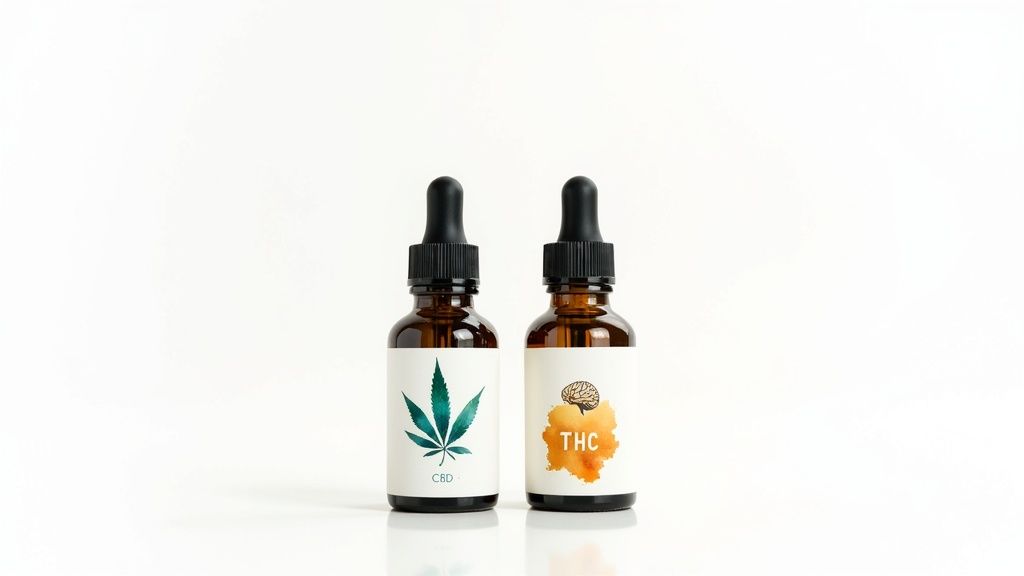
While CBD (cannabidiol) and THC (delta-9-tetrahydrocannabinol) are the two most famous cannabinoids, they work in very different ways. THC is the main psychoactive ingredient in marijuana—it’s what’s responsible for the euphoric, mind-altering feeling people associate with cannabis. It causes that "high" by binding directly with receptors in your brain.
CBD, on the other hand, is non-psychoactive. It won't produce any intoxicating effects, which means you can use it without it getting in the way of your day-to-day clarity. This is exactly why CBD has become so popular for people looking for therapeutic benefits without the high that comes with THC. Its appeal is all about finding a sense of calm or relief without the buzz.
The core takeaway is this: If you want the potential therapeutic benefits of cannabis without intoxication, CBD is your focus. If you are seeking psychoactive effects for recreational or medical reasons, THC is the compound responsible.
A Head-to-Head Comparison of CBD and THC
Seeing how CBD and THC stack up side-by-side makes their differences much clearer. Chemically, they're almost identical, but one tiny shift in their atomic structure completely changes how they affect you. This single variation influences everything, from how they're used to their legal standing.
To help you get a quick handle on their key distinctions, here’s a table that breaks down the essential traits of each cannabinoid. Think of it as your starting point for figuring out which one might be a better fit for your personal goals.
Key Distinctions Between CBD and THC
| Characteristic | CBD (Cannabidiol) | THC (Tetrahydrocannabinol) |
|---|---|---|
| Psychoactive Effect | Non-psychoactive; does not produce a "high." | Psychoactive; produces euphoria and a "high." |
| Primary Source | Primarily derived from hemp plants. | Abundant in marijuana plants. |
| Common Uses | Wellness, stress relief, inflammation, and focus. | Recreation, pain relief, appetite stimulation, and euphoria. |
| Federal Legal Status | Legal if hemp-derived and contains <0.3% THC. | Federally illegal but legal for medical/recreational use in many states. |
This at-a-glance view should give you a solid foundation. Now, we can dig a little deeper into what these differences mean for you in the real world.
How CBD and THC Interact with Your Body
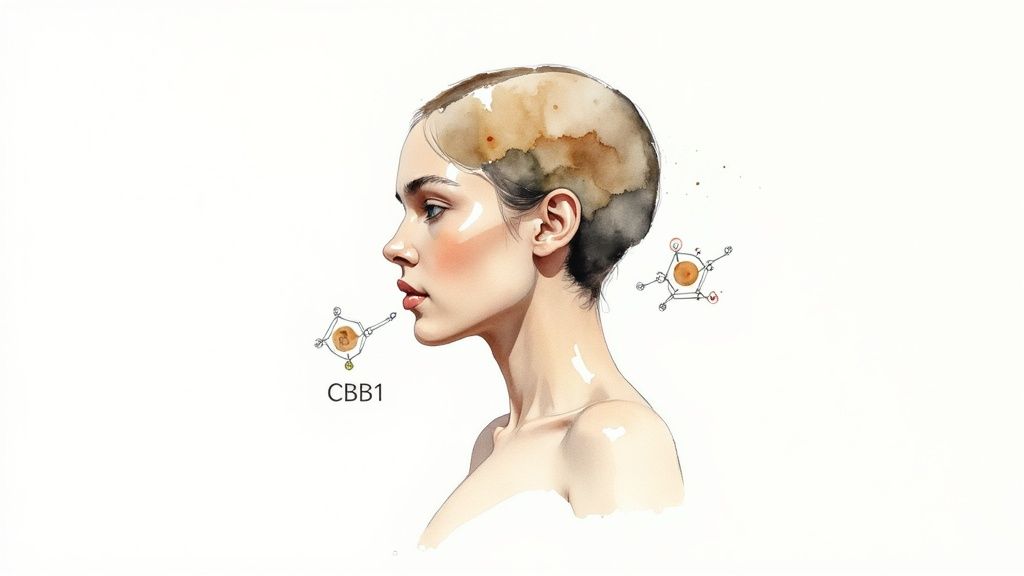
The reason CBD and THC have such different effects all comes down to how they talk to your body’s own internal cannabis network, the endocannabinoid system (ECS). Think of the ECS as your body's master regulator, a complex web of signals that keeps critical functions like your mood, sleep, appetite, and pain response in balance.
This system has receptors all over your body, but the two big ones are CB1 and CB2. You can think of them like locks, just waiting for the right key to turn them.
THC happens to be a perfect key for the CB1 receptor. These receptors are packed into your brain and central nervous system, which is exactly why THC produces its famous psychoactive effects. When THC clicks directly into that CB1 lock, it sets off a chain reaction that releases neurotransmitters, creating the euphoric "high" that changes your perception of time and enhances your senses.
CBD’s Different Approach
CBD, on the other hand, doesn't really fit the CB1 lock at all. Instead of kicking the door down like THC, it takes a much more indirect and subtle route. It acts more like a helpful manager for the entire endocannabinoid system, gently guiding it rather than taking it over.
Instead of binding directly, CBD is thought to work in a couple of clever ways:
- It gets in the way of FAAH, an enzyme that breaks down one of your body’s natural cannabinoids, anandamide—often called the "bliss molecule." By blocking the breakdown, CBD helps keep more anandamide circulating, which can promote a feeling of calm.
- It can actually change the shape of the CB1 receptor, making it harder for THC to bind as tightly. This is why a little CBD is often used to mellow out THC’s intensity and help keep any potential anxiety at bay.
CBD doesn’t hijack the system to create a high; it gently encourages your body’s own endocannabinoid system to function more efficiently. This indirect action is the core reason it provides therapeutic potential without intoxication.
What This Means for You
Understanding this difference—direct binding versus indirect influence—is key to figuring out which cannabinoid is right for your needs.
If you’re a medical patient dealing with severe nausea from chemotherapy, for instance, THC's direct action on those CB1 receptors might be exactly what you need to stimulate your appetite.
But if you’re just trying to manage everyday stress or inflammation without feeling out of it, CBD is probably the better choice. Taking a CBD tincture in the morning can help you feel calm and focused, supporting your body’s natural balance without any intoxicating effects.
This also explains why using them together works so well. A product with a 1:1 ratio of CBD to THC lets you get the benefits of both. The CBD can take the edge off any potential anxiety from the THC, leading to a much more balanced and comfortable experience. If you want to go deeper, you can learn more about specific cannabinoid effects on our blog to help you find the perfect product for your goals.
Comparing the User Experience and Therapeutic Benefits
Knowing the science is great, but what really matters is how using CBD versus THC actually feels. The experience you have with each cannabinoid is worlds apart, and it's all shaped by things like dosage, your own body chemistry, and the specific product you pick up. One delivers clear-headed therapeutic benefits, while the other offers a whole spectrum of psychoactive effects.
THC is famous for that distinct “high.” At lower doses, this usually means feeling euphoric, creative, and more in tune with your senses. Music might sound incredible, food tastes amazing, and just hanging out can feel more fun and interesting. This is exactly why THC is a go-to for social situations, creative work, or just kicking back after a tough day.
But the THC experience really hinges on how much you take. Go a little too high on the dose, and you might run into less-fun effects like paranoia or anxiety, especially if you're new to it. This is why you'll always hear the classic advice: "start low and go slow." It's all about finding what works for you.
The Subtle Influence of CBD
On the flip side, the CBD experience is all about what you don't feel—you won't get high. People who use CBD usually talk about a gentle feeling of calm, less anxiety, or just feeling more grounded and focused. It's not a sedative that knocks you out, and it’s not a stimulant that makes you jittery.
Think of CBD more like a tool that helps your body find its balance. Someone might take a CBD tincture in the morning to handle daily stress without feeling fuzzy-headed at work. Another person might rub on a CBD topical after the gym to soothe sore muscles. The goal is relief and wellness, not changing your mental state.
THC alters your perception to create a new experience, while CBD works in the background to help your body manage stress and discomfort, allowing you to feel more like your best self. This is a key differentiator in the "what is CBD vs THC" debate.
Real-World Scenarios Unpacked
Let's break this down with a couple of everyday examples to make it crystal clear.
- Scenario 1: The Social Relaxer: You're heading over to a friend's place for a chill movie night. A THC vape pen could make the movie funnier and the conversation flow a little easier. The goal here is purely recreational enjoyment and relaxation.
- Scenario 2: The Focused Professional: You've got a big presentation coming up at work and the nerves are kicking in. A dose of CBD oil beforehand could help quiet those racing thoughts and let you focus on what you need to do, without any intoxication. The goal is functional stress relief.
These situations show how your intention really guides which cannabinoid is the right choice for the moment. One is for shifting your mindset, while the other is for supporting it.
The Power of Working Together: The Entourage Effect
But the conversation isn't just about picking one or the other. CBD and THC can actually team up in what’s known as the entourage effect. The idea is that all the compounds in the cannabis plant—cannabinoids, terpenes, and more—work better together than they do on their own.
When you combine them, CBD can actually soften some of THC's stronger psychoactive effects, making anxiety less likely. This is why a lot of seasoned cannabis users look for products with a balanced 1:1 ratio of CBD to THC. You get the therapeutic upside of both without feeling overwhelmed by the high. This synergy is similar to how different strains create different vibes, which you can learn more about in our guide to indica, sativa, and hybrid strains. This combined approach lets you fine-tune your experience for a much more comfortable and customized result.
Navigating the Legal Landscape of CBD and THC
Trying to understand the legal status of CBD vs. THC can feel like untangling a giant knot of federal and state rules. It’s one of the most confusing parts for newcomers and even seasoned users. The key to making sense of it all comes down to one thing: where the product came from. Legality all hinges on whether a cannabis product is derived from hemp or marijuana.
This crucial dividing line was drawn by the 2018 U.S. Farm Bill. This was a huge piece of legislation that made hemp and its derivatives—including CBD—legal at the federal level. According to the bill, if a cannabis plant contains 0.3% THC or less by dry weight, it's legally considered hemp. This simple rule is why you can find hemp-derived CBD products just about anywhere, from gas stations to grocery stores.
On the other hand, any cannabis product with more than that 0.3% THC threshold is classified as marijuana. Despite what your state laws might say, marijuana is still a Schedule I controlled substance under federal law. This creates the tricky legal patchwork we have today, where a product can be perfectly legal in one state but highly illegal just a few miles away.
The Two Tiers of Cannabis Law
When you’re thinking about cannabis legality, you have to remember there are two sets of laws in play at all times. First, you have federal law, which gives a green light to hemp-derived CBD but puts a hard stop on marijuana.
Then, you have state laws, which are all over the map. Here in California, both recreational and medical marijuana are legal for adults. That means you can walk into a licensed dispensary like Cannavine and buy THC products as long as you’re old enough. But in other states, it might only be legal for medical patients with a doctor's note. And in some, all forms of marijuana are still completely illegal.
Here's the most important rule of thumb to remember: Hemp-derived CBD (with less than 0.3% THC) is generally legal federally. But any product derived from marijuana is entirely governed by the laws of the state you're in.
This legal split has a massive impact on the market. Last year, hemp-sourced CBD products made up 56.8% of market revenue, thanks directly to the legal head start it got from the 2018 Farm Bill. Meanwhile, the explosive growth we're seeing in the THC market is happening one state at a time as legalization spreads, unlocking billions in sales. You can dive deeper into these global cannabis market trends to see just how much regulations shape what we can buy.
Practical Guidelines for Staying Compliant
So, what does all this legal jargon mean for you? Staying on the right side of the law is actually pretty straightforward if you keep a few tips in mind.
- For CBD: Stick with products from reputable brands that provide third-party lab reports, often called a Certificate of Analysis (COA). This document is your proof that the product has 0.3% THC or less, confirming it’s a legal hemp product.
- For THC: Only ever buy from state-licensed dispensaries. Places like ours are held to strict testing and labeling standards, which guarantees the products are safe and accurately dosed. Also, be sure you know your state’s possession limits and always consume responsibly in private.
Finding the Right Product Format for Your Goals
Knowing the difference between CBD and THC is a great first step, but choosing the right product is where you really start to dial in your experience. How you consume cannabis—smoking, vaping, eating, or applying it to your skin—makes a huge difference in how quickly the effects come on and how long they stick around. It’s all about matching the product to what you’re trying to achieve.
Every format has its own timeline. Inhalation, like smoking flower or hitting a vape pen, is the fastest route, with effects kicking in within minutes. That near-instant delivery is perfect for moments when you need relief right now—think of it as a quick fix for a sudden wave of anxiety or a flare-up of pain.
On the other hand, edibles and tinctures have to go through your digestive system first. That means you'll be waiting a while, anywhere from 30 minutes to two hours, to feel anything. The trade-off? The effects last much, much longer, sometimes for several hours, making them a solid choice for managing chronic conditions or getting a full night of uninterrupted sleep.
Comparing Onset and Duration Across Product Types
To make the right call, you need to know what to expect from each product type. The best format for you really just depends on whether you're looking for speed, staying power, or targeted relief.
Here’s a simple breakdown of the most common options:
- Flower & Vapes (Inhalation): This is your fast track. Because the cannabinoids go straight into your bloodstream through your lungs, the onset is almost immediate. This makes it ideal for handling acute symptoms or for social situations where you want to feel the effects quickly. The high typically peaks fast and then fades within one to three hours.
- Edibles (Ingestion): When you eat an edible, your liver gets involved and converts THC into a more powerful compound. This process means a significant delay before you feel anything, but it also delivers a potent, long-lasting experience that can go for six hours or more. Edibles are fantastic for all-day pain relief or sleep support, but you have to be careful with dosing because of their strength.
- Tinctures (Sublingual): Tinctures are the happy medium. When you hold the oil under your tongue, some of it gets absorbed directly into your bloodstream for a pretty quick onset (15-45 minutes). The rest is swallowed, giving you longer-lasting effects. This two-pronged approach gives you a bit of speed and duration, making tinctures a super versatile pick for a daily wellness routine.
- Topicals (Topical Application): Creams, balms, and lotions are all about localized relief and won't get you high. They work by interacting with cannabinoid receptors in your skin to help with soreness and inflammation. They’re a go-to for athletes or anyone dealing with targeted muscle or joint pain.
Choosing a product is really about lining up its delivery method with what you need. If you're trying to manage sudden stress, vaping a CBD cart makes a lot more sense than waiting around for an edible. But if you need that relief to last all day, an edible is probably the smarter choice.
This simple decision tree shows how the legal pathway for a cannabis product is determined by its source—hemp or marijuana.
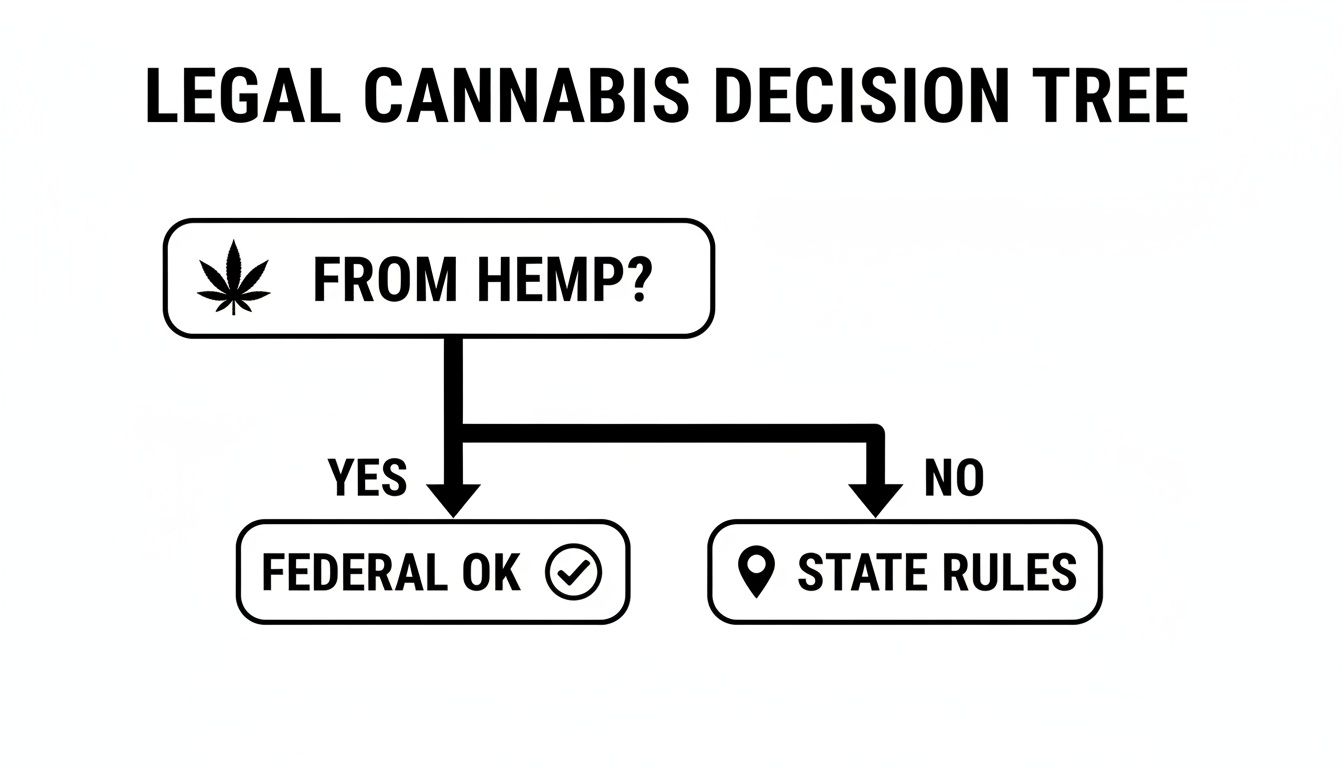
As you can see, hemp-derived products get a federal green light, while products derived from marijuana are governed by state-specific laws.
Matching Products to Your Wellness and Recreational Goals
These different product types also tell a story about the global cannabis market. Legal rules have a huge impact on what’s available, and you can see a sharp contrast in how CBD and THC are adopted around the world.
North America is the powerhouse for both, but Europe and Asia are catching up fast on the CBD front. In 2024, North America owned a staggering 86.7% revenue share of the CBD market, largely thanks to the 2018 Farm Bill legalizing hemp. This has made CBD an accessible entry point into cannabis wellness worldwide, while THC remains a heavily regulated giant, thriving mostly in North America’s recreational markets. You can dig deeper into the growth of the cannabidiol market to see how these trends are playing out.
A Practical Guide to Safe Dosing and Consumption
Knowing the difference between CBD and THC is only half the battle. Figuring out how to use them safely and effectively is where the real learning begins. Responsible consumption is all about understanding potential side effects and having a smart dosing strategy, especially when you’re just starting out.
Both cannabinoids are generally well-tolerated, but they can have side effects. THC is famous for temporary effects like dry mouth, red eyes, and dizziness. In higher doses, some people might experience anxiety or paranoia. CBD's side effects are usually much milder, sometimes including fatigue, changes in appetite, or diarrhea. These reactions are almost always dose-dependent and tend to fade as your body gets used to it.
Of course, if you experience any side effects that are persistent or concerning, it’s always a good idea to chat with a healthcare professional. They can give you personalized advice based on your health history and help you navigate your options safely.
Your Dosing Mantra: Start Low and Go Slow
If there’s one rule to live by when dosing cannabis, it's this: "start low and go slow." This is the golden rule for a reason. It means introducing a very small amount of a cannabinoid to your system and then waiting to see how you feel before even thinking about taking more. It's hands-down the safest way to find your personal "sweet spot"—that perfect dose that gives you all the benefits without any unwanted effects.
This approach is absolutely critical with edibles, which are notorious for their delayed onset and surprising potency.
- For THC Edibles: A great starting dose for a beginner is between 2.5mg and 5mg. After you eat it, wait at least two full hours. Seriously. Don't even consider taking more before then.
- For CBD Tinctures: A good starting point is usually 5mg to 10mg, once or twice a day. From there, you can slowly increase the amount every few days until you feel the relief you're looking for.
Remember, everyone’s body and endocannabinoid system are unique. What works perfectly for your friend might be way too much or not nearly enough for you. Patience is your best friend when it comes to finding the right dose.
The Importance of Lab Reports
So, how can you trust that what's on the label is actually in the product? The answer is a Certificate of Analysis (COA). A COA is just a fancy name for a lab report from a third-party tester. It verifies a product's cannabinoid content, confirming exactly how much CBD and THC it contains.
Even more importantly, a COA screens for nasty stuff you don't want, like pesticides, heavy metals, and leftover solvents. Any reputable brand will make their COAs easy to find, usually through a QR code right on the package. You should never buy a product that doesn't have a recent, easy-to-read COA available.
This is your best defense against mislabeled products and your guarantee that you're consuming something clean and safe. Some products, like Rick Simpson Oil, have very specific dosing considerations, and you can learn more about what RSO is and how to use it in our detailed guide.
Common Questions About CBD and THC
After getting the rundown on CBD and THC, you probably still have a few practical questions. Let’s tackle some of the most common things people ask, covering everything from drug tests to finding a quality product you can trust.
Will Using CBD Products Cause Me to Fail a Drug Test?
This is a huge concern for a lot of people, and the short answer is: it depends on the kind of CBD product you’re using. Most drug tests aren’t looking for CBD at all; they’re designed to screen for THC.
The potential hiccup comes from full-spectrum CBD. By law, these products can contain tiny amounts of THC (less than 0.3%). While that's nowhere near enough to feel high, if you use a lot of it consistently, that THC could potentially build up in your system and flag a positive result. It’s a small risk, but it’s real.
If you can't take any chances, stick with products clearly labeled as broad-spectrum CBD or CBD isolate. These have had all the THC removed, a claim you can double-check with a Certificate of Analysis.
Can I Use CBD and THC Together?
Absolutely. In fact, many people find they work better that way. This is what’s known as the "entourage effect"—the idea that all the plant's compounds, like cannabinoids and terpenes, work together in synergy to produce more powerful and well-rounded effects than they would alone.
When you combine them, CBD is great for smoothing out THC’s psychoactive edges. It can dial down the potential for anxiety or paranoia that some people feel with THC, leading to a much more balanced and comfortable experience. You'll see products with specific ratios like 1:1 or 5:1 CBD-to-THC, which are formulated to harness this synergy for different goals.
Which Cannabinoid Is Better for Anxiety?
If you're looking to manage everyday anxiety, CBD is usually the best place to start. It’s non-intoxicating, meaning it can bring on a sense of calm without interfering with your focus or ability to go about your day.
THC and anxiety have a more complicated relationship. For some, a low dose of THC can be incredibly relaxing. For others, especially at higher doses or for those new to cannabis, it can actually ramp up feelings of paranoia. If anxiety relief is your main goal, a CBD-dominant product is almost always the safer, more predictable bet.
How Do I Identify a High-Quality CBD or THC Product?
The single most important thing to look for is a recent Certificate of Analysis (COA). This is a lab report from an independent, third-party source that proves what’s in the product.
Any reputable brand will make its COAs easy to find, usually through a QR code right on the package. A COA will tell you two critical things:
- Cannabinoid Profile: It confirms the exact amounts of CBD, THC, and other cannabinoids, so you know you're getting what you paid for.
- Contaminant Testing: It shows the product is clean and free of nasty stuff like pesticides, heavy metals, or leftover solvents.
Beyond the COA, your best bet is always to buy from a licensed, trusted dispensary. They’re held to strict safety and testing standards, taking the guesswork out of finding a reliable product.
At Cannavine, we do the vetting for you, making it simple to find lab-tested, high-quality cannabis products you'll love. Check out our curated menu of flower, edibles, vapes, and more for easy pickup or delivery. Visit https://trycannavine.com to find exactly what you’re looking for.