At its most simple, kief is the pure, concentrated goodness of the cannabis flower. It's that dusty, golden-green powder you see at the bottom of your grinder, and it’s packed with everything that gives cannabis its unique effects and aromas.
Your Introduction to the World of Kief
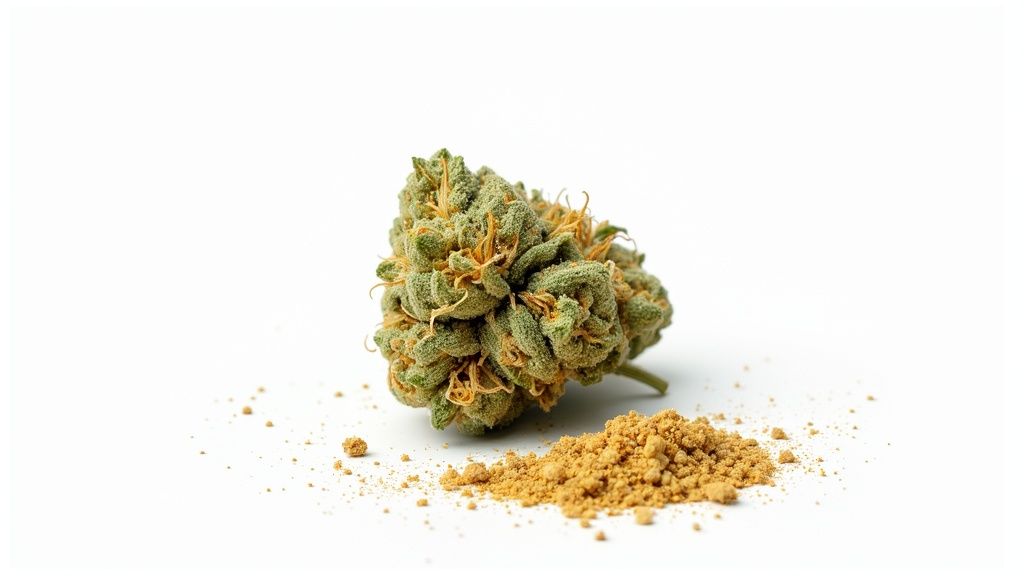
If you've ever held a top-shelf cannabis bud, you’ve seen that frosty, sparkling coating. Those aren't just pretty crystals—they're microscopic, mushroom-shaped glands called trichomes. Think of them as tiny factories dotting the surface of the plant.
This is where all the magic happens. Trichomes are responsible for producing and storing all the compounds that make each strain special, including:
- Cannabinoids: These are the active ingredients like THC and CBD that interact with our bodies to produce the plant's wide range of effects.
- Terpenes: These are the aromatic oils that give cannabis its incredible spectrum of smells and flavors, from pungent citrus and pine to sweet berry and earthy funk.
When these delicate trichomes dry and fall off the flower, they become kief. It’s a raw, potent collection of the most desirable parts of the plant, sifted and separated from the less-potent leaves and stems.
From Ancient Pleasure to Modern Potency
The name "kief" itself tells a story. It comes from the Arabic word 'kīf,' which means 'joy' or 'pleasure,' hinting at its long history of enjoyment in cultures across North Africa and the Middle East for centuries.
It really caught on in the West during the 1960s and 70s, and as growers got better at their craft, kief only became more popular. To put it in perspective, between 1995 and 2014, the average THC in cannabis flower jumped from around 4% to 12%. Kief, which is a concentrate of the most THC-rich parts, often boasts a THC content of 50-60% or even higher, making it a seriously potent product. You can dive deeper into its cultural journey with insights from industry experts.
Fundamentally, kief is the original cannabis concentrate. With just a little heat and pressure, this fine powder is easily pressed into hash, making it the simple, foundational building block for a whole world of extracts.
This process of separating the trichomes is what makes kief so special. By isolating them, you're left with a product that is worlds more flavorful and powerful than the flower it came from. This guide will walk you through everything you need to know, giving you a solid foundation to explore all the versatile ways you can enjoy kief.
Understanding Kief Potency and Purity
The main reason kief holds such a special place in the cannabis world comes down to one thing: its incredible potency. When you isolate the plant's trichomes, you're essentially collecting the pure, unfiltered essence of its power and flavor. The end result is a product that's significantly stronger than the flower it came from.
Think of it like this: cannabis flower is the whole orange, which is great on its own. Kief, on the other hand, is like a concentrated, cold-pressed orange juice—it’s the most vibrant and flavorful part, separated from all the pulp and peel. That concentration translates directly to a more intense experience.
A Leap in Cannabinoid Content
The jump in potency isn't just a small step up; it's a massive leap. Let's put some numbers to it.
A standard cannabis flower might test anywhere from 12% to 25% THC. High-quality kief completely blows those numbers out of the water. It’s pretty common for kief to pack 50% to 80% THC, making it three to four times more potent than the buds you just ground up.
This potency gap has only made kief more popular over time. As average cannabis strength grew from just 4% THC in 1995 to over 12% by 2014, many consumers started looking for more powerful options. A detailed study on cannabis potency shows these trends clearly. Even as concentrates have become more mainstream, kief still holds its own unique spot in the market.
To see just how big the difference is, take a look at this side-by-side comparison:
Kief vs Cannabis Flower: A Potency Comparison
| Attribute | Kief | Cannabis Flower |
|---|---|---|
| Typical THC % | 50% – 80% | 12% – 25% |
| Composition | Concentrated trichome heads | Buds, leaves, stems |
| Purity | High (mostly cannabinoids & terpenes) | Lower (contains plant matter) |
| Experience | Intense, fast-acting | Milder, more gradual |
As you can see, kief is in a totally different league. By stripping away all the extra plant material, you get a pure concentration of the good stuff.
By focusing solely on the trichome heads, you eliminate the less potent plant material, leaving behind a pure concentration of the cannabinoids and terpenes that define a strain's effects and signature aroma.
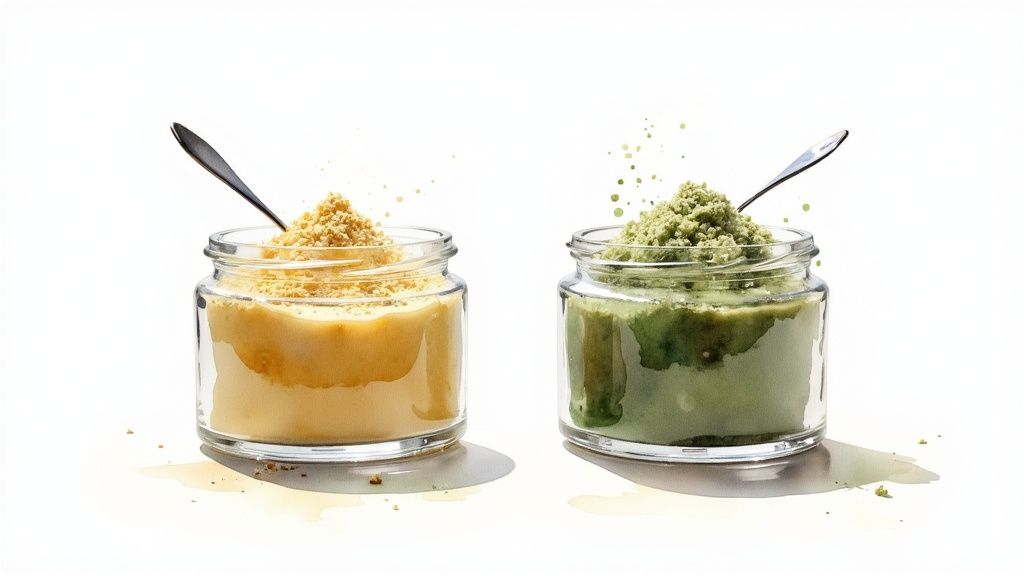
How to Judge Kief Quality by Color
Not all kief is created equal, and thankfully, its color is a super reliable indicator of quality. A quick visual inspection can tell you pretty much everything you need to know about its purity.
You can judge it using a simple color scale:
- Golden or Off-White: This is the jackpot. A vibrant, light, sandy color means the powder is almost entirely pure trichome heads with very little contamination. This is the stuff that will deliver the most potent effects and the cleanest flavor.
- Greenish Tint: If your kief has a noticeable green color, it means a good amount of finely ground plant material (like tiny leaf bits) got mixed in. It’ll still be stronger than flower, but it’s definitely less pure. That extra plant matter can make it taste harsher when smoked and will lower the overall cannabinoid percentage.
Ultimately, you want to find kief that is as light and golden as possible. When you see that brilliant, sandy color, you know you've found the good stuff.
Effective Methods for Collecting Kief
Harvesting your own kief is surprisingly simple, and you might already be doing it without even realizing it. There are a few different ways to go about it, from everyday tools to more specialized gear for bigger batches. No matter the method, the goal is always the same: to shake those potent trichome heads loose from the rest of the plant.
One of the best parts about collecting kief is that it's basically a zero-waste bonus of enjoying flower. Instead of letting all that potent powder get stuck to your fingers or the side of a jar, you can collect it for a supercharged session down the road. Let’s walk through the most common ways to build up your own stash of this golden dust.
The Grinder Kief Catcher
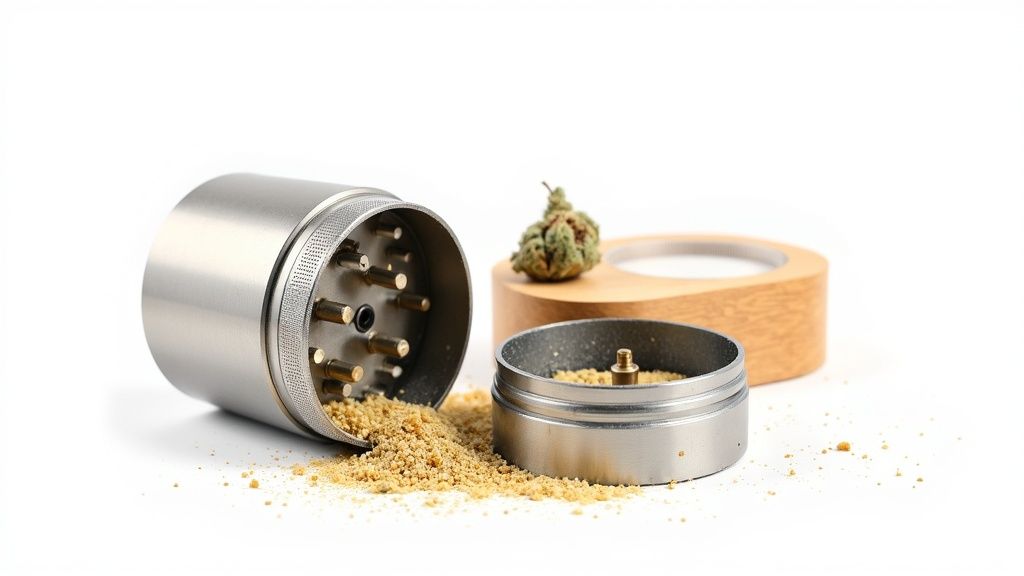
For most of us, the easiest and most common way to collect kief is with a multi-chamber grinder. These handy gadgets are built not just to grind your flower, but also to sift and save the trichomes that break off in the process. It’s a totally passive method that requires zero extra effort.
A typical three or four-piece grinder has a few distinct parts:
- Grinding Chamber: The top section with the "teeth" where you put your flower.
- Collection Chamber: The middle area where the ground-up flower lands, ready to go.
- Sifting Screen: This fine mesh screen is the floor of the collection chamber, and it only lets the tiny trichomes fall through.
- Kief Chamber: Right at the bottom is the "kief catcher," where all that magical dust slowly builds up over time.
This is the perfect set-it-and-forget-it approach for the daily consumer. It takes a little patience to see a good amount accumulate, but opening it up to find a nice pile is always a welcome surprise.
Pro Tip: Want to speed things up? Drop a clean dime or a small coin into the middle chamber with your ground flower. A gentle shake will make the coin bounce around, knocking more trichomes loose and down through the screen.
Sifter Boxes for Larger Yields
If you're looking to process more than just a nug at a time, a sifter box (or kief box) is the next logical step. These are designed specifically for dry sifting cannabis and getting a decent amount of kief all at once. They’re usually a simple wooden box with a fine mesh screen separating the top from the bottom.
Using one couldn't be easier:
- Break up your cannabis flower and spread it across the screen.
- Close the lid and give the box a gentle shake from side to side.
- The tumbling motion makes the brittle trichomes snap off and fall through the screen into the collection tray below.
The biggest advantage here is volume. You can sift through several grams of flower in just a few minutes, which is way faster than waiting for your grinder's kief catcher to fill up. To get an even better return, try popping your cannabis in the freezer for about 15-20 minutes first—this makes the trichomes extra brittle and ready to separate.
Large-Scale Mechanical Separation
When you get to the commercial level, producers and serious connoisseurs rely on machinery to do the heavy lifting. These methods use mechanical agitation to separate kief from huge volumes of cannabis material with incredible efficiency.
- Mechanical Tumblers: Think of a large, rotating drum lined with a mesh screen. As it spins, the cannabis tumbles around inside, and the kief gets sifted out into a collection bin.
- Vibrating Sifters: These machines use high-frequency vibrations to literally shake the trichomes loose from the plant matter. The kief then falls through a series of screens to refine it.
While you probably won't have one of these in your living room, they work on the exact same principles as a simple sifter box: agitation and filtration. Once you understand that concept, you can collect your own top-notch kief with whatever tools you have on hand.
Creative Ways to Use Kief Effectively
Once you've collected that beautiful, golden powder, a whole world of possibilities opens up. Kief is incredibly versatile. Think of it as a potent ingredient that can supercharge your existing cannabis routine or even be transformed into entirely new products. Because it's so fine and powdery, it's easy to work with and lets you precisely dial in the potency of your experience.
From simple upgrades to full-on infusions, knowing what to do with kief is the key to unlocking its power. Let's get into the most popular and effective ways to put those hard-earned trichomes to good use.
Sprinkle and Supercharge Your Smoke
The easiest, most common way to use kief is to simply add it to your flower. This move requires zero extra equipment and instantly boosts the potency and flavor of whatever you're smoking.
A few classic techniques work wonders:
- Crown a Bowl: Instead of mixing it all in, try gently sprinkling a layer of kief on top of a packed bowl in your pipe or bong. This "crowned" bowl gives you an extra-potent start to your session as the kief ignites first.
- Layer It In: For a much smoother, more even burn, make a kief sandwich. Pack your bowl halfway with flower, add a thin layer of kief, and then top it off with more flower. This protects the delicate kief from the direct flame, letting it vaporize slowly and more efficiently.
- Twax a Joint: Take your pre-roll to the next level by "twaxing" it. Just lightly moisten the outside of a rolled joint with a tiny bit of concentrate oil (or just lick it), then carefully roll it in kief. You'll end up with a frosty, high-THC coating. You can also just sprinkle kief inside the joint before rolling for a more low-key boost.
Press Kief into Hash
Ever wonder what the real difference is between kief and hash? The answer is just heat and pressure. Hash is simply kief that has been compressed into a solid block. This process changes its texture, deepens its flavor, and makes it way easier to handle and store.
You can even make your own simple hash right at home with a couple of basic tools.
- Gather Your Materials: You'll need your kief, a small piece of parchment paper, and a heat source like a hair straightener or an iron.
- Prepare the Kief: Neatly fold the parchment paper in half and place your kief right in the center.
- Apply Heat and Pressure: Using the lowest heat setting you can, firmly press the parchment paper for just a few seconds (5-10 seconds is plenty). You should see the powder darken and melt into a more solid, oily form.
- Cool and Collect: Let the parchment cool down completely before you open it. The compressed kief will now be a small, dark puck of hash, ready to be broken up and enjoyed.
Create Potent Kief Edibles
Kief is a fantastic ingredient for making edibles. Since it contains very little plant matter, it gives your creations a much cleaner, less "weedy" flavor than using whole flower. But there's one critical step you absolutely cannot skip: decarboxylation.
Raw kief contains THCA, which is a non-psychoactive acid. To feel its effects, you have to heat it to convert that THCA into active THC.
Decarboxylation is the key that unlocks the psychoactive potential of your kief. To do it, just spread your kief on a baking sheet lined with parchment paper and bake it at 240°F (115°C) for about 30-40 minutes. It should look slightly toasted and smell very fragrant when it's done.
Once decarbed, your kief is ready to be infused into fats like butter or coconut oil. Simply simmer the fat and your activated kief together on low heat for a couple of hours, then strain it and use it in any recipe you like.
Vaping Kief for Maximum Flavor
For anyone who really prioritizes flavor, vaping kief is the way to go. Using a dry herb vaporizer at lower temperatures lets you experience the full spectrum of a strain's terpenes without any of the harshness of smoke.
When you vape kief, always sandwich it between layers of ground flower. This little trick prevents the fine powder from getting sucked through the vape's screen or clogging up the heating chamber. Start with a low temperature (around 350°F or 177°C) to really enjoy the delicate terpene flavors, then slowly increase it to fully vaporize the cannabinoids. This method gives you clean, potent, and incredibly flavorful hits.
While you generally don't dab raw kief, you can press it into rosin first for a more concentrated experience. For more information on that process, you can explore our detailed guide on how to dab cannabis concentrates.
Kief, Hash, and Other Cannabis Concentrates Explained
Diving into the world of cannabis concentrates can feel like a lot to take in, with so many different names and textures out there. But here’s the secret: almost all of them start from the exact same place—kief.
Think of kief as the raw material, the pure and simple starting point for many of the most powerful products on dispensary shelves. It’s the original concentrate, collected with nothing more than a screen. This simplicity is what makes it so special.
Kief vs. Hash: What's the Difference?
The oldest and most direct upgrade for kief is turning it into hash, also known as hashish. It's a surprisingly simple process. The only real difference between kief and hash is the addition of a little heat and pressure.
When you warm up and press kief, those tiny, resin-packed trichome heads burst open and fuse together. This transforms the loose powder into a solid, dense, and often dark block of hash. The process doesn't just change the form; it deepens the flavor, too. The heat can coax out richer, earthier notes from the terpenes that you don't always get from raw kief.
At the end of the day, hash is just a more compact, convenient, and slightly more complex version of its dusty parent.
Kief Compared to Other Modern Concentrates
While making hash is a straightforward step, crafting today's other popular concentrates often involves much more complex extraction methods. Many modern techniques use solvents to strip the good stuff—cannabinoids and terpenes—from the plant material, creating products with sky-high potency.
Here are a few you'll commonly see:
-
Shatter and Wax: These products are made by using chemical solvents like butane or propane to dissolve the trichomes off the plant. Once the plant matter is filtered out, the solvent is carefully removed, leaving behind a potent extract that can range from glass-like and brittle (shatter) to soft and crumbly (wax).
-
Rosin: As a completely solventless extract, rosin is a much closer cousin to hash. It’s made by applying a precise amount of heat and immense pressure to either cannabis flower, hash, or kief. This process literally squeezes the pure resinous sap right out of the material. If you want to learn more, check out our guide on what is rosin.
To help you get a clear picture of how these all stack up, here’s a quick comparison.
Understanding Cannabis Concentrates
| Concentrate Type | Production Method | Typical Consistency | Average THC % |
|---|---|---|---|
| Kief | Mechanical Separation (sifting) | Fine, loose powder | 30% – 60% |
| Hash | Heat and pressure applied to kief | Solid, dense, oily block | 40% – 70% |
| Rosin | Heat and pressure (solventless) | Sap-like, buttery, or waxy | 75% – 90% |
| Shatter/Wax | Solvent-based extraction (BHO/PHO) | Glassy, taffy-like, or crumbly | 70% – 90%+ |
As you can see, while they all come from the same plant, the journey from trichome to final product creates a wide range of potencies and experiences.
Think of it like this: if kief is like raw cacao nibs, then hash is a simple, rustic chocolate bar. Other concentrates like wax, shatter, and rosin are the gourmet truffles—each one more refined, but all coming from that same potent source.
The infographic below perfectly illustrates the three main ways you can put this incredibly versatile material to use.
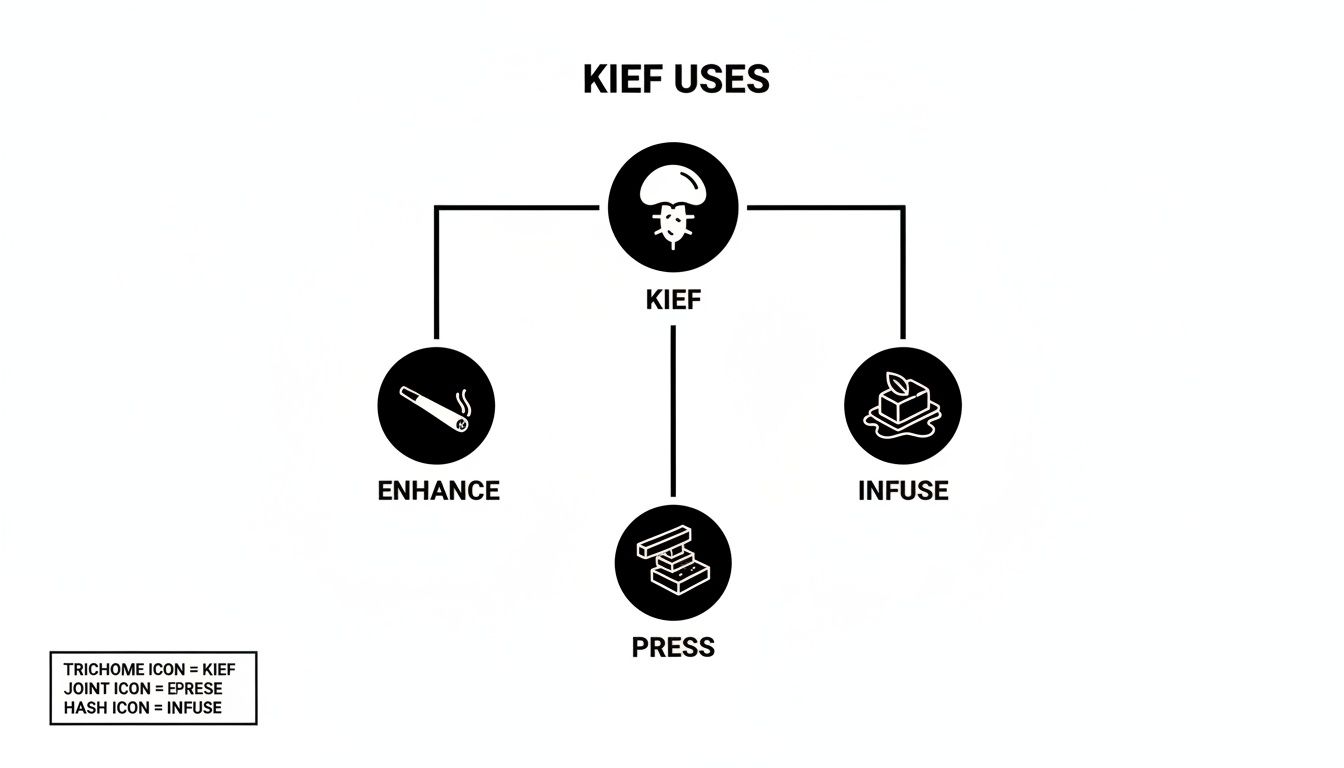
Whether you're sprinkling it on a bowl to enhance your flower, pressing it into hash, or infusing it into edibles, kief is the foundation.
How to Purchase and Store High-Quality Kief
Walking into a California dispensary and trying to pick out the right kief can feel a bit overwhelming at first. Just like flower, not all kief is created equal, and the quality can range pretty widely. Knowing what to look for before you even step up to the counter is the best way to make sure you walk out with something you'll actually enjoy.
The single most reliable way to judge quality is by checking the Certificate of Analysis (COA)—that's the official lab report. This document is your window into what's really going on inside that little container, breaking down the exact cannabinoid and terpene content. You'll want to look for high THC percentages for potency and a solid terpene profile for those rich flavors and specific effects. Here at Cannavine, we make sure everything on our shelves is fully tested, so you never have to guess about what you're buying.
Choosing the Right Kief at the Dispensary
When you're looking at kief in person, your eyes are your best friend. As we've touched on, top-shelf kief should have a light, sandy, or even golden-blonde color. If you spot a distinctly green tint, that's a red flag for excess plant matter, which will only lead to a harsher smoke and less potent experience.
Don't be shy about asking your budtender what strain the kief came from, either. Knowing if it's an Indica, Sativa, or Hybrid gives you a much better idea of the effects you can expect. This helps you match the kief to the vibe you're going for, whether it's creative energy or pure relaxation.
The demand for potent concentrates like kief is undeniable. Its super-high THC content—often hitting 50-80% compared to the 12-25% you'll find in flower—makes it a fan favorite. To put it in perspective, in a market like Washington back in 2022, the average THC in kief was triple that of flower, but it stayed incredibly affordable at around $10-20 per gram. You can find more cool stats on how concentrates are shaping the industry from market analysts.
The Best Way to Store Your Kief
Once you've got your kief home, storing it properly is key to keeping it fresh and potent. Its fine, powdery texture makes it super susceptible to a few common enemies: light, heat, and oxygen. These elements will break down cannabinoids and terpenes, robbing your kief of both its power and its flavor over time.
Want to keep your kief fresh? The golden rule is simple: store it in an airtight container, and keep it somewhere cool and dark. This one little step protects its delicate chemical profile, making sure every pinch is just as good as the last.
Follow these quick tips, and you'll keep your kief in prime condition for months:
- Pick the Right Container: A dark-colored or opaque glass jar with a lid that seals tight is your best bet. Glass is non-porous, so it won't mess with the flavor.
- Find a Cool, Dark Spot: Think of a cabinet, a drawer, or a closet that stays at a nice, consistent temperature. You'll want to avoid places that get hot or have wild temperature swings, like near a window or on top of your TV.
- Keep Air Out: Try to use a container that's just the right size for the amount of kief you have. The less empty space, the less oxygen there is to degrade those precious trichomes.
Stick to these guidelines, and your kief will stay potent and flavorful for the long haul. For an even deeper dive, check out our complete guide on storing weed, which has great tips for all your cannabis goodies.
Got Kief Questions? We've Got Answers
Even after getting the basics down, you might still have a few questions floating around. That’s totally normal. This last section is all about tackling the common queries we hear at the shop from newcomers and seasoned smokers alike. Let's clear the air so you can enjoy your kief with total confidence.
We'll cover everything from smoking it straight to making sure it stays fresh, giving you the straightforward answers you need.
Is It Safe to Smoke Kief by Itself?
Yes, you can absolutely smoke kief on its own, but you’ll want to be careful. Since it’s a concentrate, pure kief packs a much bigger punch than flower and hits you faster. Its potency is no joke, so a tiny pinch goes a very long way. Always start with way less than you think you need.
The biggest challenge is its powdery texture. It can fall right through a standard bowl or clog up your piece. To get around this, use a pipe screen or a bowl designed for finer material. Honestly, though, most people prefer to just mix it with a bit of flower for a much smoother, more even burn.
How Much Kief Can I Expect to Collect?
That really depends on a few things: the quality of your cannabis, how dry it is, and what you're using to collect it. A top-shelf, frosty flower is naturally going to give you more trichomes to work with.
If you’re using a standard multi-chamber grinder, you can generally expect to gather about 5% to 10% of the flower's weight in kief over time. So, if you grind up an ounce of cannabis (28 grams), you could end up with somewhere between 1.4 and 2.8 grams of kief. Using a dedicated sifter box can bump that number up a bit.
The rule of thumb is simple: the frostier the bud, the more golden powder you'll be able to harvest. High-resin strains are always your best bet for maximizing your kief collection.
Can Kief Go Bad Over Time?
Kief doesn't "spoil" like milk, but it definitely degrades and loses its magic. Its worst enemies are light, heat, air, and moisture. When exposed to these, the cannabinoids and terpenes start breaking down, which tanks both the potency and the flavor.
Keep it in a cool, dark, and airtight container, and your kief can stay fresh and potent for months. If you store it improperly, you’ll notice it gets darker and tastes harsher. The THC also slowly converts to CBN, a cannabinoid known for making you sleepy, which will change the whole experience.
What Is the Difference Between Green and Golden Kief?
The color of your kief is the easiest way to judge its purity. Just use your eyes—it’s a pretty simple quality check.
- Golden or Off-White Kief: This is the good stuff. A light, sandy color means your kief is almost entirely pure trichome heads with very little plant gunk mixed in. This is what you want for the cleanest flavor and the highest cannabinoid content.
- Green-Tinted Kief: If it has a noticeable green hue, it means a good amount of finely ground plant material (like tiny bits of leaf) made its way into your collection. It's still stronger than flower, but this greener kief is less pure, might taste a bit harsher, and will have a lower overall THC percentage.
At Cannavine, we believe that understanding cannabis is the first step to enjoying it responsibly. Our curated selection of lab-tested products, including high-quality kief and concentrates, ensures you always know exactly what you're getting. Explore our menu today to find the perfect addition to your collection. Visit us online at https://trycannavine.com to shop for pickup or delivery.