The real difference between full spectrum and broad spectrum CBD boils down to one simple thing: full spectrum CBD contains tiny amounts of THC (up to 0.3%), while broad spectrum CBD has all the THC removed. This single detail is a game-changer, influencing everything from potential benefits to whether you’ll pass a drug test.
Decoding the CBD Spectrum
When you start looking into CBD, you'll see "full spectrum" and "broad spectrum" pop up everywhere. These aren't just fancy marketing terms; they tell you exactly what kind of cannabinoid and terpene mix is in your product. Getting this right is the first step to picking an oil, edible, or topical that actually fits your goals and your life.
What Each Spectrum Contains
-
Full Spectrum CBD: Think of this as a whole-plant extract. It keeps all the natural goodies found in the hemp plant, including over 100 cannabinoids (like CBD, CBG, and that little bit of THC), plus aromatic terpenes and flavonoids.
-
Broad Spectrum CBD: This one starts its life as a full spectrum extract but goes through an extra step to specifically remove the THC. It holds onto all the other helpful cannabinoids and terpenes, so you still get a rich profile, just without any THC.
Both extracts aim to create the "entourage effect"—the idea that all these cannabis compounds work much better together than they do alone. But whether THC is part of that team or not creates two very different experiences.
Your choice between full spectrum and broad spectrum really comes down to one question: Are you comfortable with, and legally able to consume, trace amounts of THC?
Full Spectrum vs Broad Spectrum CBD At a Glance
For anyone who needs a quick, no-nonsense breakdown, this table cuts right to the chase. It lays out the key differences so you can see how they stack up side-by-side.
| Feature | Full Spectrum CBD | Broad Spectrum CBD |
|---|---|---|
| THC Content | Contains up to 0.3% THC | THC is removed to non-detectable levels (0.0%) |
| Cannabinoid Profile | The complete range of cannabinoids and terpenes | A wide range of cannabinoids and terpenes, just no THC |
| Entourage Effect | The full synergistic effect of all plant compounds working together | A powerful entourage effect, but without THC's contribution |
| Drug Testing Risk | A low but real risk of a positive test with high-dose, consistent use | The safer bet for anyone who gets regular drug screenings |
Ultimately, this little table can be your quick reference guide as you decide which path is right for you.
Understanding the Entourage Effect
At the heart of the full spectrum vs broad spectrum CBD debate is a fascinating concept called the entourage effect. It’s not just a buzzword; it’s the scientific idea that cannabis compounds work better together than they do alone. This synergy is the main reason why many seasoned users reach for full spectrum products.

Think of it like a classical orchestra. A single violin can play a beautiful melody, no doubt. But when the cellos, violas, and basses join in, the music becomes incredibly rich and complex. Each instrument adds its unique voice, creating a complete experience that one instrument could never achieve on its own.
In a full spectrum CBD extract, CBD is the lead violinist, supported by a whole ensemble of other natural plant compounds.
The Key Players in the Entourage Effect
The "orchestra" in full spectrum CBD has two main sections that work together to create the magic:
- Cannabinoids: The cannabis plant contains over 100 of these compounds. This includes CBD, CBG (Cannabigerol), CBN (Cannabinol), and—this is the important part—tiny amounts of THC (Tetrahydrocannabinol). Each one interacts with our body’s endocannabinoid system in a unique way. You can learn more about the unique impact of each cannabinoid in our other guides.
- Terpenes: These are the aromatic oils that give cannabis its signature scents, from earthy pine to bright citrus. Terpenes like myrcene, limonene, and linalool do more than just smell good; they have their own therapeutic effects and can even influence how your body absorbs and uses the cannabinoids.
When all these elements work together, the therapeutic benefits are greater than the sum of their parts. It’s this powerful synergy that’s driving the huge consumer demand for products that deliver the whole plant profile.
In fact, the global full spectrum CBD oil market was valued at USD 2.01 billion in 2024 and is expected to grow to USD 3.64 billion by 2032. North America alone made up about 41.56% of that market in 2024, showing just how popular these products are here in the U.S. and Canada. You can read the full research on this growing market trend on databridgemarketresearch.com.
How Broad Spectrum Modifies the Effect
So, what happens when you make a broad spectrum product by removing the THC? The orchestra keeps playing, but a key instrument is now missing. Broad spectrum CBD still has a rich mix of beneficial cannabinoids and terpenes, so it creates its own powerful entourage effect.
But the specific interactions that involve THC are gone. This results in a modified entourage effect. For anyone who can't have THC or simply prefers to avoid it, broad spectrum is an excellent option that’s still much more effective than a CBD isolate (which is just pure, solo CBD).
The Takeaway: Full spectrum CBD gives you the complete, unaltered entourage effect with all the plant’s compounds, including trace amounts of THC. Broad spectrum offers a potent, but modified, synergistic effect by keeping everything except the THC.
This is the key difference. Neither one is necessarily "better"—it all comes down to what's right for you. The choice depends on whether the potential benefits of having that tiny bit of THC outweigh your personal, professional, or legal reasons for avoiding it.
Navigating THC Content, Legality, and Drug Tests
When you’re weighing full spectrum against broad spectrum CBD, the conversation almost always lands on one thing: THC. For many people, this is the make-or-break factor, especially if you have work or personal reasons to steer clear of it completely. Understanding the real-world implications of THC content is key to making the right choice.
On a federal level, full spectrum CBD products derived from hemp are perfectly legal, but there’s a catch: they must contain no more than 0.3% THC by dry weight. This tiny amount isn’t enough to get you high, but it’s there to help create the entourage effect. Broad spectrum CBD, on the other hand, goes through an extra step to specifically remove all detectable THC, which is why you’ll see it listed as 0.0% on lab reports.
The Real Risk of a Drug Test
The main worry for most people isn't that tiny bit of THC itself, but whether it could show up on a drug test. This is where the line between full spectrum and broad spectrum becomes crystal clear. Can that 0.3% THC in a full spectrum product actually make you fail a screening?
The answer is a little complicated, but the short version is: yes, it’s possible.
While taking a single dose is extremely unlikely to cause a positive test, consistently using high doses of full spectrum CBD day after day introduces a real risk. THC is fat-soluble, which means it can build up in your body’s fat cells over time. If you’re taking a full spectrum product daily, that THC can accumulate faster than your body can get rid of it, potentially tipping you over the threshold that standard drug tests look for.
This isn't just a hypothetical risk; people have failed drug screenings from consistent use of federally legal full spectrum products. For professionals, athletes, or anyone who gets tested regularly, it's a possibility you can't just ignore.
Who Should Stick to THC-Free Products?
Broad spectrum CBD was created for this exact reason—to give people the benefits of the entourage effect without any of the THC. It’s the go-to choice for anyone who wants total peace of mind.
You should probably opt for broad spectrum if you are:
- A Professional in a Zero-Tolerance Field: This is a big one for pilots, commercial drivers, federal employees, healthcare workers, and first responders who operate under strict workplace drug policies.
- An Athlete: Many sports organizations have tight anti-doping rules that ban any amount of THC.
- A First-Time User: If you're new to cannabis and feeling a little hesitant about THC, broad spectrum is a great way to start. You can see how your body feels with other cannabinoids first.
- Someone with a Personal Preference: Some people are just really sensitive to THC or simply choose to avoid it.
For anyone in these groups, the full spectrum vs broad spectrum CBD decision is pretty simple. Broad spectrum gives you a rich profile of helpful cannabinoids and terpenes but takes away the biggest source of anxiety.
Market Demand and What It Means for You
The huge demand for both full and broad spectrum products has created a massive global market, and different places have their own preferences. North America, for instance, has become the dominant player, making up a huge chunk of the global cannabidiol market revenue—with some estimates putting its share as high as 86.7% in 2024. This means what U.S. consumers want—whether it's THC-inclusive full spectrum oils or THC-free broad spectrum options—drives what companies make all over the world. You can find more insights on the expansive CBD consumer health market on precedenceresearch.com.
This multi-billion dollar market is built on giving people clear choices. Companies know that serving customers who want to avoid THC is just as important as catering to those looking for the whole-plant experience.
Ultimately, dealing with THC and drug tests comes down to honestly looking at your own life and job. While full spectrum CBD gives you the complete entourage effect, its trace THC introduces a small but very real risk for anyone facing a screening. Broad spectrum completely removes that risk, offering a powerful and worry-free alternative.
How to Choose the Right CBD for Your Lifestyle
Figuring out whether to go with full-spectrum or broad-spectrum CBD isn't about finding which one is "better" overall. It's about what’s right for you—your needs, your comfort level, and even your job.
Instead of just listing pros and cons, let's look at a few common scenarios. Think about which one sounds the most like you, and the full spectrum vs broad spectrum CBD decision will get a whole lot easier.
For the Cautious First-Time User
Just starting with CBD? The idea of consuming any amount of THC, even a tiny bit, can feel a little daunting. You want to see what all the fuss is about—the calm, the balance—without any nagging worries.
For this reason, broad spectrum CBD is the perfect starting point. You get to introduce your system to a rich blend of cannabinoids and terpenes, letting you see how your body responds in a completely THC-free zone. It’s a great way to build confidence and understand what CBD can do for you.
For the Experienced User Seeking Maximum Benefits
Now, what if you've been around the block with CBD? Maybe you're looking for more powerful support for something chronic, like persistent pain or serious stress. You’re comfortable with the cannabis plant and don't have to worry about drug tests.
In this situation, full spectrum CBD is the clear winner. That small amount of THC—up to 0.3%—is the key to unlocking the full entourage effect. It works together with CBD and all the other plant compounds to really amplify the benefits, often providing more noticeable relief.
The choice really boils down to one simple question: Can you have any THC in your system? If drug tests are a part of your life, this decision tree makes it crystal clear.
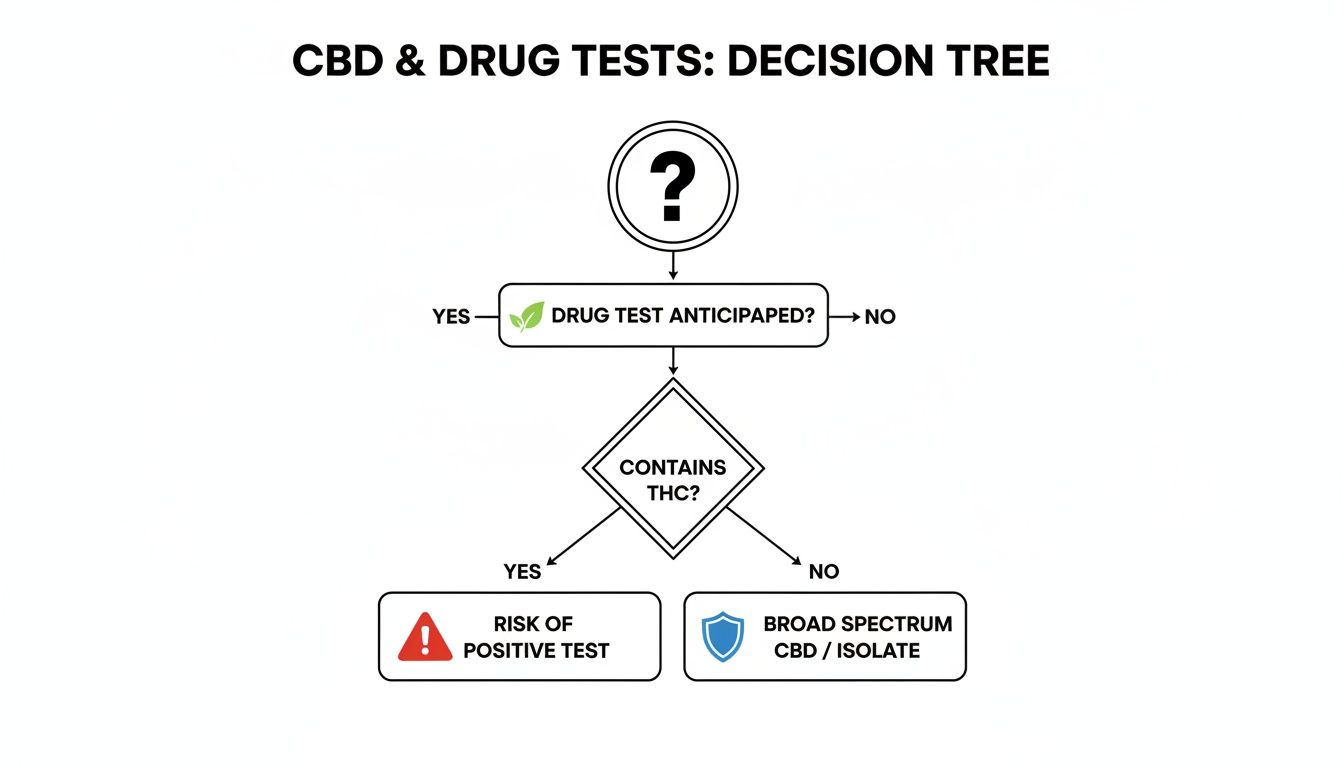
As you can see, if a drug test is even a remote possibility, broad-spectrum is your only truly safe bet.
For the Professional or Athlete
Let's say you're a pilot, first responder, federal employee, or an athlete subject to strict anti-doping rules. A positive drug test isn’t just an awkward conversation; it could derail your career.
There's no gray area here: broad spectrum CBD is the only responsible choice. While the risk of testing positive from a full-spectrum product is low, it's not zero. THC is fat-soluble, meaning it can build up in your body over time with regular use. Broad-spectrum products have the THC removed down to non-detectable levels, giving you total peace of mind.
For a deeper dive into making smart choices, check out our complete guide on choosing the right cannabis products for your needs.
For Specific Wellness Goals Like Sleep or Anxiety
What if you're trying to tackle something specific, like getting better sleep or managing daily anxiety? Both types of CBD can help, but the best one often depends on what's driving the issue.
- For Anxiety: Some people find the complete profile in full spectrum products more grounding. For others, however, even trace amounts of THC can make them feel a bit more on edge. If you know you're sensitive to THC, broad spectrum is the way to go for anxiety.
- For Sleep: Full spectrum often gets the nod here. The combination of CBD, trace THC, and other minor cannabinoids like CBN is a powerhouse for promoting relaxation and supporting a healthy sleep cycle.
In the end, it all comes down to being honest about your lifestyle, your job, and your personal goals. Match the product to your circumstances, and you’ll find the CBD that works best for you.
How to Read CBD Lab Reports with Confidence
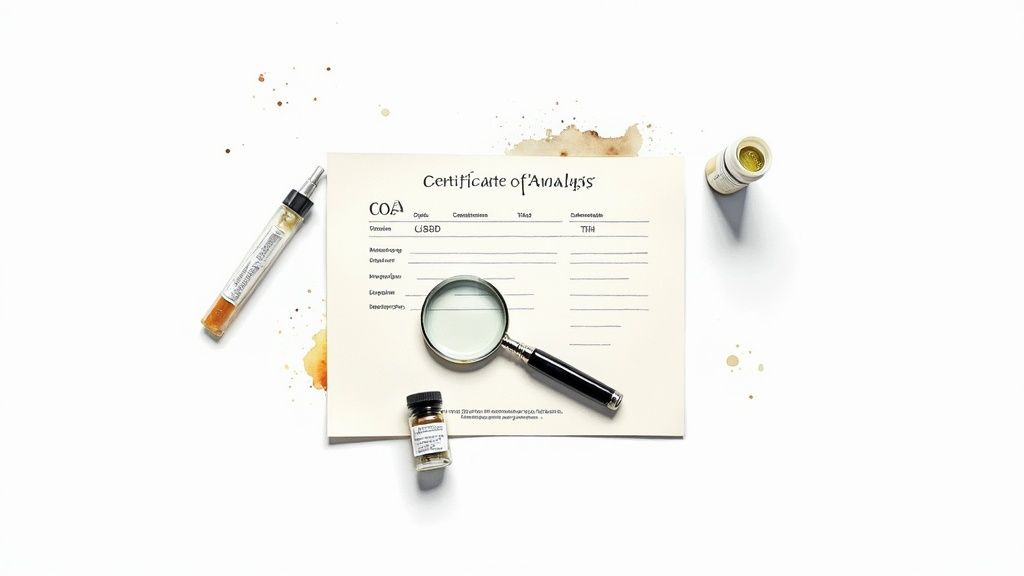
Making a smart choice between full-spectrum and broad-spectrum CBD isn’t just about trusting the label—it’s about verifying its claims. The only way to really know what's in your product is to look at its third-party lab report, also called a Certificate of Analysis (COA). Any brand worth your money will make these easy to find for every single product.
Think of the COA as the product's report card. It's an unbiased breakdown of exactly what’s in the bottle, from the good stuff (cannabinoids and terpenes) to the contaminants you want to avoid (pesticides, heavy metals, and solvents). Honestly, learning how to read one is the single best skill you can have as a CBD user.
Checking the Cannabinoid Profile
First things first, find the cannabinoid analysis. This section is sometimes called the potency report, and it's where you'll confirm whether your product is truly full-spectrum or broad-spectrum. Look for a list of cannabinoids and their concentrations.
- For Full Spectrum: You should see CBD as the main event, followed by a lineup of minor cannabinoids like CBG, CBN, and CBC. The key is to find a value for Delta-9 THC that is present but below the 0.3% legal limit.
- For Broad Spectrum: You'll see a similar rich profile of CBD and other cannabinoids. The big difference? The value for Delta-9 THC should be listed as "ND" (Non-Detect), "LOD" (Limit of Detection), or simply 0.0%. This is your proof that the THC has been removed.
A common mistake is just trusting the label. The COA is the proof. If a product claims it's "THC-Free" but the lab report shows detectable THC, you've found a brand you can't trust.
Verifying Terpene Content
Beyond cannabinoids, a good COA will show you a terpene analysis. Terpenes are the aromatic compounds that give the plant its scent and flavor, and they play a huge role in the entourage effect.
This section tells you which terpenes are in the mix and in what amounts. For example, you might see myrcene, which is known for its relaxing effects, or limonene, which can be more uplifting. A rich terpene profile is usually a great sign of a high-quality extract. If you're curious about how these compounds shape your experience, you can dive deeper into terpene profiles and their effects.
Ensuring Product Safety and Purity
Last but definitely not least, a complete COA must include safety testing. This is non-negotiable. You need to know you’re consuming a clean, safe product, and this part of the report confirms it has passed tests for nasty contaminants.
Look for these key safety panels:
- Pesticides: Confirms the product is free from nasty agricultural chemicals.
- Heavy Metals: Checks for stuff you don't want, like lead, mercury, and arsenic.
- Residual Solvents: Makes sure no harmful chemicals are left over from extraction.
- Microbials: Screens for bacteria, mold, and yeast.
If a COA only shows the fun stuff—cannabinoids and terpenes—but skips these safety tests, it’s a major red flag. By learning to scan these three sections, you can verify any product's claims and protect yourself from low-quality or even unsafe options.
Finding Your Ideal Product at Cannavine
Okay, so you've got the scoop on the whole full spectrum vs broad spectrum CBD debate. Now it's time for the fun part: putting that knowledge to work. Here at Cannavine, our entire goal is to make finding the right product straightforward and transparent, so you can always shop with total confidence.
Every single product we carry has an accessible Certificate of Analysis (COA). This is your proof. You can personally verify if a product is full spectrum by looking for that tiny amount of THC (always under 0.3%) or confirm it's broad spectrum by spotting a 0.0% or "Non-Detect" THC result. Just ask any of our budtenders, and we'll pull up the lab report for anything you're curious about.
Choosing the Right Product Form
Beyond the spectrum, how you take your CBD makes a big difference. The various product forms offer unique benefits, and we've stocked a wide variety to match any goal you might have.
- Tinctures and Oils: These are the go-to for fast absorption. You take them under the tongue (sublingually), and they get to work quickly. They’re perfect if you're looking for fast, all-over effects and want to dial in your exact dose for things like daily stress or getting better sleep.
- Edibles and Gummies: If you want relief that lasts, edibles are your friend. They take a bit longer to kick in because they have to be digested, but the effects can go on for hours. This makes them ideal for consistent support throughout your day.
- Topicals and Creams: Got sore muscles or achy joints? Topicals are the answer. They deliver cannabinoids right to the spot that's bothering you without ever entering your bloodstream, providing targeted, localized relief.
At Cannavine, our budtenders are experts at matching your needs to the right product. Don't be shy—ask for a personal recommendation based on your lifestyle and what you're trying to achieve.
How to Shop with Cannavine
We’ve made it super easy to get what you need, whether you like to browse in person or order from your couch. Our online menu is updated in real-time, so it always shows exactly what's in stock at our San Francisco, Santa Rosa, Ukiah, and Belmont locations.
You can check out our entire selection online, place an order for a quick in-store pickup, or even get same-day delivery where it’s available. It’s all about making sure you can get access to top-shelf, lab-tested products without the hassle.
Questions to Ask Our Budtenders
When you stop by, come loaded with questions! Our team lives and breathes this stuff and is here to give you clear, helpful answers so you walk out with something you'll love.
Not sure where to start? Try one of these:
- "I'm worried about a drug test. Can you point me toward your best broad spectrum options?"
- "I need the strongest possible entourage effect for chronic pain. What full spectrum products would you recommend?"
- "I'm totally new to CBD. What's a good product form for a beginner?"
By combining what you've just learned with our team's hands-on expertise, you’ll be able to navigate our shelves like a pro and find the perfect CBD product to support your well-being.
Frequently Asked Questions
When you're trying to figure out the difference between full spectrum and broad spectrum CBD, a few questions always seem to pop up. Getting those answered is the last step before you can pick the right product with real confidence.
Will Full Spectrum CBD Get Me High?
Let's clear this one up right away: absolutely not. Full spectrum products do have a tiny amount of THC—up to the legal limit of 0.3%—but that's nowhere near enough to cause a "high" or any intoxicating effects.
That trace amount is there for one reason: to help activate the entourage effect for therapeutic benefit, not to change your mental state.
Is Broad Spectrum CBD Less Effective Than Full Spectrum?
"Less effective" isn't really the right way to look at it. Broad spectrum CBD is still incredibly effective on its own, delivering a great synergistic effect from its mix of cannabinoids and terpenes.
The real difference is that it provides a modified entourage effect since the THC is completely removed. For some people, especially those managing more chronic issues, the complete profile in a full spectrum product might offer a little extra oomph. For many others, a THC-free broad spectrum formula works perfectly.
Which Spectrum Is Better for Anxiety?
This is a really personal decision. Some people find that the full cannabinoid profile in full spectrum CBD gives them a more grounded, complete sense of calm. The tiny bit of THC can really round out the therapeutic benefits.
On the other hand, if you're particularly sensitive to THC, even that trace amount could make you feel a little uneasy. For anyone in that camp, broad spectrum CBD is definitely the way to go. You still get all the anxiety support from the other cannabinoids, but without any THC in the mix.
The best advice is to know yourself. If you’ve ever felt anxious after using THC, your best bet is to start with broad spectrum. It’s all about finding what makes you feel comfortable and positive.
How Long Does It Take for CBD to Work?
How quickly you feel the effects really depends on how you take it, not which spectrum you choose. Different products get absorbed by your body at different speeds.
- Tinctures (Under the Tongue): These get to work fast. Because the cannabinoids absorb right into your bloodstream, you'll typically feel the effects within 15-30 minutes.
- Edibles and Gummies: These have to go through your digestive system first, so you'll need to be a bit more patient. They usually take about 45-90 minutes to kick in.
- Topicals: When you apply CBD to your skin, it provides targeted, localized relief. You'll usually start to feel it working in about 15-20 minutes.
Choosing the right method is just as important as picking the right spectrum to get the results you're looking for.
At Cannavine, our team is always here to answer any other questions you might have. Feel free to explore our lab-tested selection of premium CBD products online or stop by the store to chat with an expert and find the perfect match for your wellness journey.