When it comes to the great live resin vs distillate debate, it really boils down to what you're looking for. Think of live resin as a full-spectrum extract that gives you the authentic flavor and aroma of the cannabis plant, while distillate is a super-refined oil built for one thing: maximum potency. The right choice for you depends entirely on whether you want a rich, true-to-the-plant experience or a powerful, clean, and versatile effect.
Unpacking The Core Differences
Choosing between live resin and distillate is a lot like picking an olive oil. On one hand, you have unrefined, cold-pressed extra virgin olive oil, which is packed with nuanced flavor and character. On the other, you have a pure, neutral vegetable oil that serves as a versatile base ingredient. To make the best choice, you have to understand what makes them so different right from the start.
Live resin is made from cannabis plants that are flash-frozen right after harvest. This special process locks in all the delicate terpenes and cannabinoids that give a strain its unique personality. The result is a concentrate celebrated for its complex taste and smell, delivering an experience that’s incredibly close to smoking the original flower. If you want to get into the nitty-gritty, you can learn more about what live resin is and why so many connoisseurs swear by it.
Distillate, on the other hand, goes through an intense refinement process. It's designed to strip away everything except a specific cannabinoid, which is usually THC. This creates an incredibly strong product—often testing over 90% THC—but at the cost of its natural terpenes, which are responsible for flavor and the famous "entourage effect."
Key Takeaway: Live resin keeps the plant's natural profile intact for a full sensory experience. Distillate zeroes in on a single cannabinoid for sky-high potency but leaves the natural flavors and aromas behind.
This core distinction shapes everything, from how they taste and feel to the best ways to enjoy them.
Quick Comparison Live Resin vs Distillate
To help you see the fundamental differences between these two popular concentrates at a glance, here’s a quick breakdown of their key attributes.
| Attribute | Live Resin | Distillate |
|---|---|---|
| Starting Material | Fresh-frozen cannabis | Dried, cured cannabis |
| Flavor Profile | Strong, authentic, strain-specific | Neutral, often flavorless |
| Terpene Content | High (5-15%+) | Very low to none |
| THC Potency | High (60-80%) | Very High (85-95%+) |
| Spectrum | Full-spectrum | Isolate (single cannabinoid) |
| Primary Goal | Preserve flavor and aroma | Maximize potency and purity |
| Appearance | Darker, amber to light yellow | Clear, light golden-yellow |
This table makes it clear: if you're chasing the pure essence of a specific strain, live resin is your go-to. If you just want maximum THC content for edibles or a neutral vape, distillate is the obvious choice.
How Extraction Methods Define Each Concentrate
The unique personalities of live resin and distillate are born from how they’re made. Both start as cannabis, but their paths split right after harvest, creating two concentrates with completely different missions. Understanding this fork in the road is everything when it comes to appreciating why one is famous for authentic flavor and the other for pure, raw power.
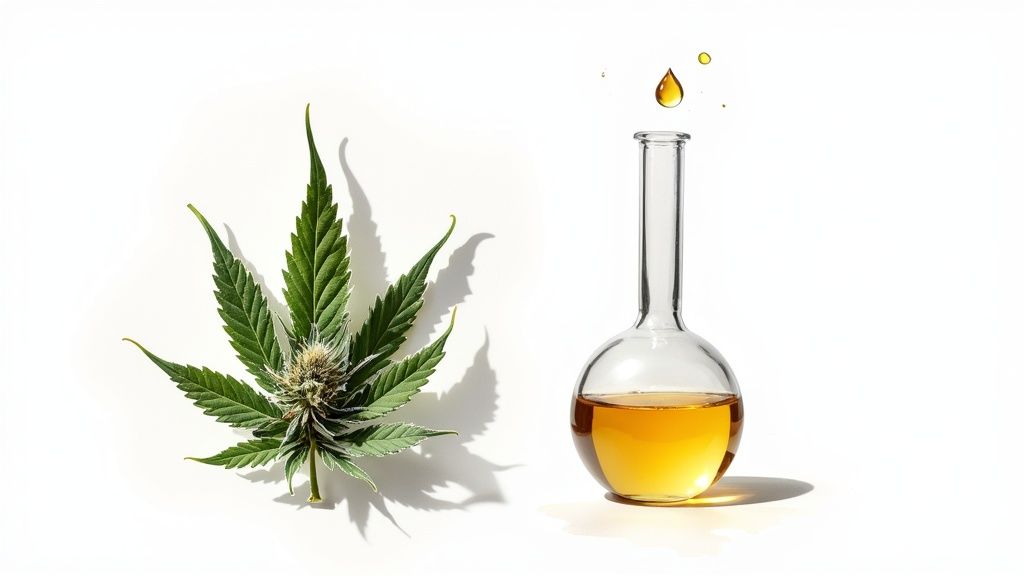
Live resin’s journey is a race against the clock to preserve the plant's living essence. Distillate’s path is a methodical process of purification, designed to isolate just one compound. This core difference in philosophy defines everything that follows.
The Live Resin Process Capturing The Plant Profile
Making live resin kicks off the second the plant is harvested. Instead of the usual drying and curing, cannabis plants destined for live resin are flash-frozen on the spot, often within an hour of being cut. This is the critical step that puts the "live" in live resin.
This deep freeze locks in the plant's entire chemical profile, especially the super-volatile terpenes. Terpenes are the fragrant oils that give a strain its unique smell and flavor, and they start evaporating the moment the plant is cut. By freezing the plant, producers save these delicate molecules before they disappear.
The extraction process that comes next is just as specialized:
- Sub-Zero Temperatures: The frozen plant material stays at cryogenic temperatures during the entire extraction.
- Solvent Extraction: A solvent like butane or propane is passed through the frozen cannabis, pulling out the cannabinoids and all those saved terpenes.
- Gentle Purging: The mix is then gently warmed in a vacuum oven to get rid of any leftover solvent, but not so hot that it boils away those precious terps.
This careful, low-temperature method gives you a "full-spectrum" concentrate—a snapshot of the living plant, packed not just with THC but also with minor cannabinoids and a ton of terpenes.
The entire live resin process is designed around one goal: preservation. It sacrifices higher THC percentages and yield in favor of maintaining the authentic, complex chemical signature of the source strain.
The Distillate Process Engineering Purity
Distillate production takes a very different road, one focused on refinement and isolation. It usually starts with dried, cured cannabis biomass—which can be trim or lower-quality flower that wouldn't make the cut for premium products. Right off the bat, this makes the process more economical.
First, a standard extraction creates a crude cannabis oil. This initial oil is a messy mix of cannabinoids, terpenes, fats, lipids, and other plant gunk. It’s what happens next that makes distillate what it is.
The crude oil goes through a process called short-path distillation. This is a slick technique that uses the different boiling points of various compounds to separate them with incredible precision. The process involves carefully heating the crude oil under a vacuum, which causes specific compounds to turn into vapor.
That vapor travels a short distance (hence "short-path") to a cold surface, where it condenses back into a liquid and is collected. By dialing in the temperature just right, processors can isolate specific cannabinoids—most often, THC. This cycle is often repeated to get the oil as pure as possible, stripping away everything else.
The result is an ultra-refined, golden, translucent oil that is almost entirely pure THC, often testing above 90%. But this intense purification process removes all the original terpenes, leaving a potent but completely odorless and flavorless product. The comparison between live resin vs distillate extraction is a clear case of flavor preservation versus cannabinoid isolation.
Analyzing Potency, Terpenes, And The Entourage Effect
When we move past extraction methods, the real differences between live resin and distillate start to show up in their chemical profiles. On paper, the potency numbers might look straightforward, but there’s a lot more to the story than just THC percentage. It’s about the entire cocktail of compounds from the plant working in harmony.

This is where these two concentrates truly go their separate ways, and it impacts everything from the intensity of the high to the flavor you taste.
Distillate: The Power Of Pure Potency
If we're talking about sheer cannabinoid strength, distillate is the undisputed champ. The whole point of its meticulous refinement process is to isolate a specific cannabinoid—usually THC—and get it as pure as possible.
This laser focus creates a product that’s celebrated for one thing: raw power. It’s pretty standard for THC distillates to test between 85% and 95% total cannabinoids, with THC making up nearly the entire profile. That purity happens because the distillation process is designed to strip out just about everything else.
But that incredible potency comes at a cost. The same heat-heavy process that isolates THC also removes nearly all of the original terpenes and other minor cannabinoids. What you're left with is powerful, but it's a very one-dimensional experience.
Live Resin: A Holistic Chemical Profile
Live resin brings a different kind of strength to the table—one built on complexity, not just purity. By flash-freezing the plant right after harvest, it manages to keep the full spectrum of compounds intact.
Its THC content is usually a bit lower than distillate, often landing somewhere between 60% and 80%. But that number doesn't really capture what live resin is all about. What it might give up in peak THC, it more than makes up for with its rich terpene profile.
- High Terpene Content: It's not uncommon for live resin to contain 5% to 15% terpenes by weight, which is a huge number for a concentrate.
- Strain Authenticity: Because of those terpenes, the smell and taste are a true reflection of the original cannabis strain it came from.
- Minor Cannabinoids: It also holds onto other cannabinoids like CBG and CBN, which play their own roles in the overall effect.
This cocktail of cannabinoids and a heavy dose of terpenes is what gives live resin its dynamic, layered experience.
The Entourage Effect: This is the idea that cannabinoids and terpenes work better together. They create a more robust and nuanced high than any single compound could on its own. The combined effect is greater than the sum of its parts.
The Entourage Effect In Action
The entourage effect is really the heart of the debate when you're comparing the feeling of live resin versus distillate. It explains why a live resin with 70% THC can sometimes feel more potent or well-rounded than a distillate clocking in at 90% THC.
A good way to think about it is like listening to an orchestra. Distillate is like having one virtuoso soloist—the THC—playing at full blast. It's incredibly powerful and direct, but it's still just a single instrument.
Live resin, on the other hand, is the full orchestra. The THC is still the lead instrument, but it's backed by a whole symphony of terpenes and other cannabinoids. The myrcene might bring in a relaxing vibe, the limonene could add an uplifting note, and the pinene might sharpen the focus.
This synergy is what we call a "full-spectrum" experience. It’s a similar concept to what you see in the CBD world, which we explore in more detail in our guide to full-spectrum vs broad-spectrum CBD.
Ultimately, choosing between them is about what you want out of your cannabis. If you’re after a predictable, high-octane buzz driven purely by THC, distillate is your go-to. If you prefer a more complex, strain-specific experience shaped by a wide array of plant compounds, you’ll probably find yourself reaching for live resin.
Comparing Flavor, Aroma, And The User Experience
The chemical breakdown of a concentrate is one thing, but what really matters is how it all comes together in the real world—the taste, the smell, the overall feeling. This is where the differences between live resin and distillate really hit home, moving from an on-paper debate to a full-on sensory experience. It's where you decide if you're after authentic complexity or predictable consistency.
For anyone who puts flavor and aroma first, live resin is the undisputed champion. Thanks to its incredibly high terpene content, it delivers a vibrant, complex experience that's a true snapshot of the living cannabis plant it came from. The entire point of making live resin is to capture that "fresh-from-the-garden" scent and taste.
When you use live resin, you're tasting a specific strain in its truest form. A puff of a Tangie live resin vape will explode with bright, authentic citrus, while a dab of GMO live resin will have that unmistakable funky, savory profile everyone loves. It’s a pure, unadulterated, strain-specific journey.
Distillate: The Versatile Blank Slate
Distillate, on the other hand, sits at the complete opposite end of the spectrum. After its intense purification process, the final oil is almost entirely odorless and flavorless. This isn't a bug; it's a feature. This neutrality is exactly what makes distillate so useful for products like edibles, where you definitely don't want a weedy aftertaste.
When it comes to vape cartridges, though, that lack of flavor is a problem that needs solving. Producers have to add terpenes back into the THC oil to make it enjoyable to smoke. This is a crucial difference in the live resin vs. distillate conversation.
These added terpenes usually come from two places:
- Botanical Terpenes: These are sourced from other plants—think lemons, pine trees, or lavender. They're cheap and can create some pleasant, predictable flavors, but they often taste a bit artificial or candy-like compared to the real deal.
- Cannabis-Derived Terpenes (CDTs): These terpenes are extracted from actual cannabis plants. While they are a big step up from botanical sources, they're often a mix from various strains and still can't quite replicate the unique synergy of a single plant's original terpene profile.
What this means is that a "Sour Diesel" flavored distillate vape gives you an interpretation of that strain's flavor, not the authentic taste itself.
The experience with distillate is engineered for consistency and potency. Live resin offers an authentic, nuanced sensory profile that can vary from batch to batch—just like the plants themselves.
Experience Beyond Flavor: Dabbing And Vaping
How you actually consume these concentrates also makes a huge difference. For dabbers, live resin provides a complex and aromatic session where different temperatures can unlock different flavor notes. Learning how to properly dab cannabis concentrates is key to making sure you don't burn off those delicate terpenes.
In contrast, distillate offers a much more straightforward and predictable experience. Since the flavor is added in, it tastes the same from the first hit to the last. This is perfect for users who just want a simple, no-fuss session that focuses purely on the effects of THC.
Ultimately, your choice comes down to what you prioritize. Do you want the rich, complex, and authentic flavor of a specific cannabis strain? Or do you prefer a consistent, potent, and often more discreet experience where the flavor is secondary or created to your liking? Answering that question will point you straight to the right product for your needs.
Choosing The Right Concentrate For Your Goals
When it comes to the live resin vs. distillate debate, the best choice really boils down to one simple question: what are you trying to get out of your experience? It’s not about which one is better overall, but which one is better for you in that moment. Once you have a clear picture of what makes each one unique, you can easily pick the concentrate that lines up with your goals.
If you’re looking for a potent, reliable, and no-nonsense high, distillate is a fantastic pick. Its sky-high THC content and nearly nonexistent flavor profile make it incredibly versatile, especially if you value consistency and discretion. It's the go-to for making edibles or for simple vape pens where you want the same effect every single time.
On the other hand, if you're a flavor chaser who wants the real-deal taste and full-spectrum vibe of a specific strain, live resin is your champion. Its rich terpene content delivers a more nuanced and aromatic experience that many connoisseurs are after. This makes it perfect for dabbing or using with advanced vaporizers that are built to handle its delicate compounds.
Scenarios For Selecting Distillate
Distillate's biggest strengths are its purity and its ability to adapt. It shines in situations where a clean, high-THC foundation is more important than the natural character of the cannabis plant.
You might want to go with distillate if:
- You're making edibles: Its neutral taste won’t mess with your recipes, and its activated THC ensures you get accurate, potent doses without any extra work.
- Discretion is key: Vapes made with distillate produce very little odor, making them a great choice for subtle, on-the-go use.
- You prefer consistent, added flavors: If you enjoy predictable fruity or candy-like tastes in your vape, distillate is the perfect blank canvas for added botanical terpenes.
- Your main goal is pure THC potency: For a powerful, straightforward effect without any frills, distillate delivers one of the highest concentrations you can find.
Distillate is the ultimate utility player in the world of concentrates. Its value comes from its ability to deliver potent, isolated cannabinoids reliably and discreetly across a wide range of products.
When To Opt For Live Resin
Live resin is made for the cannabis enthusiast who truly appreciates the finer details. It’s the concentrate you pick when you want to savor the unique essence of a strain and feel the magic of the entourage effect.
You should reach for live resin if:
- Flavor and aroma are your top priorities: Nothing else gets you closer to the authentic taste and smell of the living cannabis plant.
- You want a full-spectrum experience: The rich mix of cannabinoids and terpenes creates a more layered, well-rounded high.
- You enjoy dabbing: A good dab rig or e-rig can fully unlock the complex terpene profile of live resin for an unmatched sensory session.
- Strain-specific effects matter to you: If you’re looking for the energetic buzz of a sativa or the relaxing calm of an indica, live resin keeps those distinct characteristics intact.
This flowchart can help you visualize the decision based on what you value most.
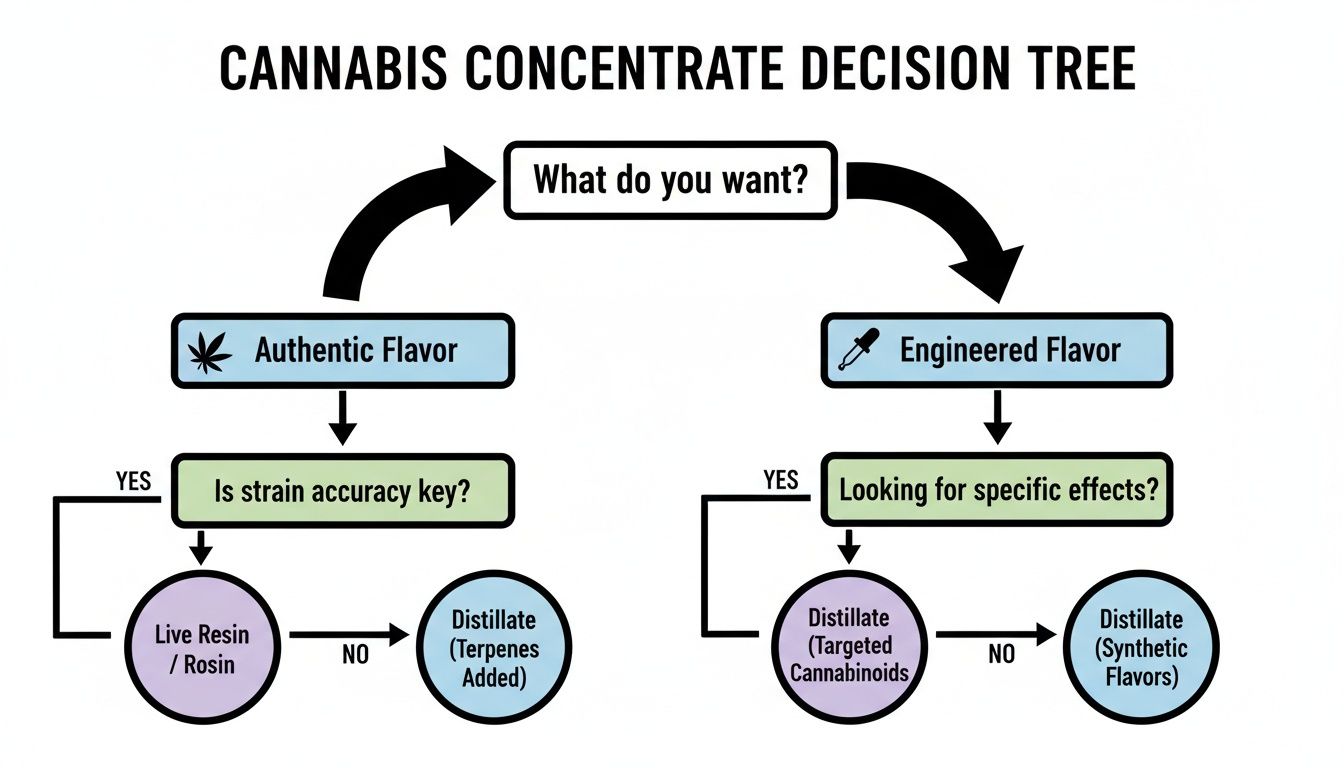
As the chart shows, your path starts with a simple choice: are you after authentic plant flavor, or a more controlled, engineered experience?
The growing demand for authenticity is really shaking up the market. Over the last five years, live resin has gone from being a niche product to a major force in the vape world, especially here in California. While distillate used to dominate the U.S. vape scene, by 2024 live resin’s share grew to 27.5% of vape sales in California as more and more people started choosing terpene-rich options over highly processed THC. You can explore more data on these evolving consumer preferences to see the trends for yourself.
Understanding Price Points And Market Value
When you’re browsing the concentrate selection at Cannavine, one of the first things you’ll probably notice is the price difference between live resin and distillate. Live resin almost always has a higher price tag, and knowing why is key to understanding the value you're getting. This price gap isn't random; it's a direct reflection of the very different paths these two products take from plant to package.
Live resin's premium cost comes from its demanding and delicate production process. It all starts with flash-freezing only the highest-quality cannabis flower right at harvest, which requires specialized equipment and careful handling from the get-go. The extraction itself is a sophisticated lab procedure needing skilled technicians to keep everything at cryogenic temperatures. The result is a lower overall yield compared to other methods, but an unmatched flavor and terpene profile.
Distillate: A Focus On Efficiency And Potency
Distillate, on the other hand, is a much more economical product to create. Processors aren't limited to pristine buds; they can use a wide variety of starting material, including dried flower and trim, which brings the initial cost way down. The distillation process is also incredibly efficient, designed to strip everything away and maximize the yield of a single cannabinoid—usually THC. This approach makes distillate a more budget-friendly option, especially for anyone whose main goal is simply high potency.
Ultimately, the live resin vs. distillate price debate is all about what you value. With live resin, you're paying for the preservation of a full spectrum of delicate compounds, an authentic cannabis flavor, and the complete entourage effect. With distillate, the value is in its pure potency and versatility in products like edibles and vape pens.
Think of it this way: The price of live resin reflects its craft, farm-to-table nature. The price of distillate reflects its refined, industrial efficiency. Both offer excellent value depending on your consumption goals.
Market Trends And Consumer Demand
The market reflects these two distinct value propositions perfectly. Live resin is seeing huge growth as a premium category, with some forecasts projecting the live resin cartridge market to hit roughly $2.5 billion by 2025. At the same time, distillate continues to dominate in sheer volume, expected to hold a 40-45% market share of all extracts because of its wide use in edibles, topicals, and high-THC vapes. You can dive deeper into these concentrate market dynamics to see how consumer tastes are shaping the industry.
This split shows a healthy, thriving market. Whether you're a connoisseur chasing authentic flavor or a consumer who just needs a potent, versatile option, there's a perfect product waiting for you.
Common Questions About Live Resin And Distillate
Even after breaking down the differences, a few key questions always seem to pop up. We get these all the time at the shop, so let's clear them up and help you pick the right product with confidence.
Is Live Resin Stronger Than Distillate?
This is probably the number one question we hear, and the answer isn't as simple as you'd think.
If we're talking pure THC content, distillate is the clear winner. It's common to see distillates test between 85-95% THC, whereas live resin usually lands in the 60-80% THC range.
But "stronger" doesn't just mean a higher THC number. Many people feel that live resin delivers a more powerful, nuanced, and complete high. This comes down to the "entourage effect," where all the original cannabinoids and terpenes from the plant work together. It creates an experience that's much closer to smoking high-quality flower than just isolating the THC.
Which Is Better For Edibles?
For anyone making edibles at home, distillate is the way to go, hands down. It's almost flavorless, which means your brownies will taste like brownies, not a pine forest. Plus, it comes pre-activated (a process called decarboxylation), so you can mix it right into your recipe without any extra steps.
Live resin, on the other hand, has a very strong and specific flavor that can easily take over your culinary creations. It also needs to be decarboxylated before it's effective in an edible, which adds another tricky step to the process.
Key Insight: Distillate's purity and neutral taste make it perfect for cooking. Save the live resin for dabbing or vaping, where you can actually enjoy its complex flavors and aromas as intended.
How Can I Tell The Difference In A Vape Cartridge?
At a glance, telling the two apart in a vape cart is pretty straightforward once you know what to look for.
First, check the box. The packaging is your best friend. It should clearly say "100% Live Resin" or "Full-Spectrum." Distillate carts are often just labeled "Distillate" and might mention that botanical terpenes were added back in for flavor.
Next, just look at the oil itself. Live resin tends to be darker, anywhere from a light yellow to a rich amber. Distillate is famous for its almost-clear, translucent golden color. And if all else fails, the price tag is a good clue—authentic live resin is always more expensive because of the complex way it's made.
Ready to explore the authentic flavors of live resin or the pure potency of distillate? Cannavine offers a curated selection of premium concentrates and vape cartridges from California's most trusted brands. Shop our online menu for pickup or delivery and find the perfect product for your goals today.